

John Ratsey
-
Posts
253 -
Joined
-
Last visited
Content Type
Profiles
Forums
Events
Posts posted by John Ratsey
-
-
Various recent notebookcheck reports about the 2026 LG grams:
https://www.notebookcheck.net/LG-releases-new-14-inch-laptops-before-global-launch.1231070.0.html
https://www.notebookcheck.net/LG-releases-new-14-inch-laptops-with-Intel-Panther-Lake.1260806.0.html
https://www.notebookcheck.net/LG-Gram-Book-15-sacrifices-processor-performance-for-a-much-quieter-fan.1239295.0.html
https://www.notebookcheck.net/Less-than-1-2-kg-LG-releases-lightweight-new-16-inch-laptop-with-120-Hz-OLED-display.1260808.0.html
https://www.notebookcheck.net/LG-gram-Pro-AI-2026-16Z90U.1240959.0.html
https://www.notebookcheck.net/LG-releases-new-17-inch-laptop-with-Intel-Panther-Lake-and-32-GB-RAM.1260807.0.html -
Last week I finally got round to moving everything across from the 2024 gram Pro 17 (17Z90SP) to the 2025 gram Pro 17 (17Z90TP). I've left the new machine running with the low fan setting as based on my research noted above. The reduced fan noise is much appreciated as I'm often working in a quiet room. There is the occasional bit of laggyness if too many things are competing for the CPU at the same time but this is an acceptable trade-off for not having bursts of annoying fan noise.
There was cause for concern when I told my Eset antivirus to do a full scan and there was a BSOD (the first I had encountered in the Windows 11 era). In fact there were three as I made three attempts at doing the scan and I wondered if there was a hardware problem which hadn't shown up during the initiral testing. I ran the full Windows memory test and then the full SSD check in Crucial Storage Executive. Both of these revealed no hardware problems so I concluded that the virus scan had tripped up on a corrupted file which is rare but not unknown. I've not tried doing another scan and will wait to see if other problems appear which merit spending time on trouble-shooting.
-
1 hour ago, extremecarver said:
In Taiwan it's now on presales. The X7/32/1gb model sells for 77.000 ntd (2076 Euro ) with list price of 79.900 NTD. Delivery by 25-30 April.
Seems ssd prices are more affected than RAM. Big SSD are really expensive now while the RAM surcharge is not that out of line.
With 7% VAT in Taiwan let's see where pricing in Europe and USA will end up.
Your comment prompted me to compare the price of SSDs I've bought in the past 2 1/2 years with the current prices. All are now more than double except for a Crucial X9 4TB portable SSD which I bought in November 2023 for £180 and is now £299. It's possible that the price of this dropped further between when I bought it and the recent price hike. It was available on Amazon for £199 only 3 months ago.
Fortunately, the 2TB and 4TB SSDs in my current gram 17 (about to get transferred to the newer gram 17) both appear to have plenty of remaining life according to Crucial Storage Executive.
-
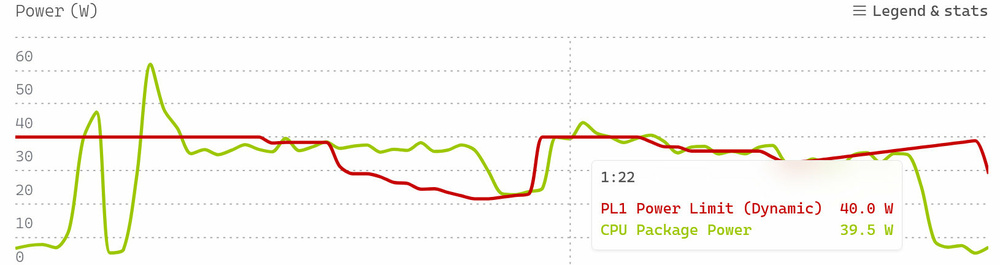
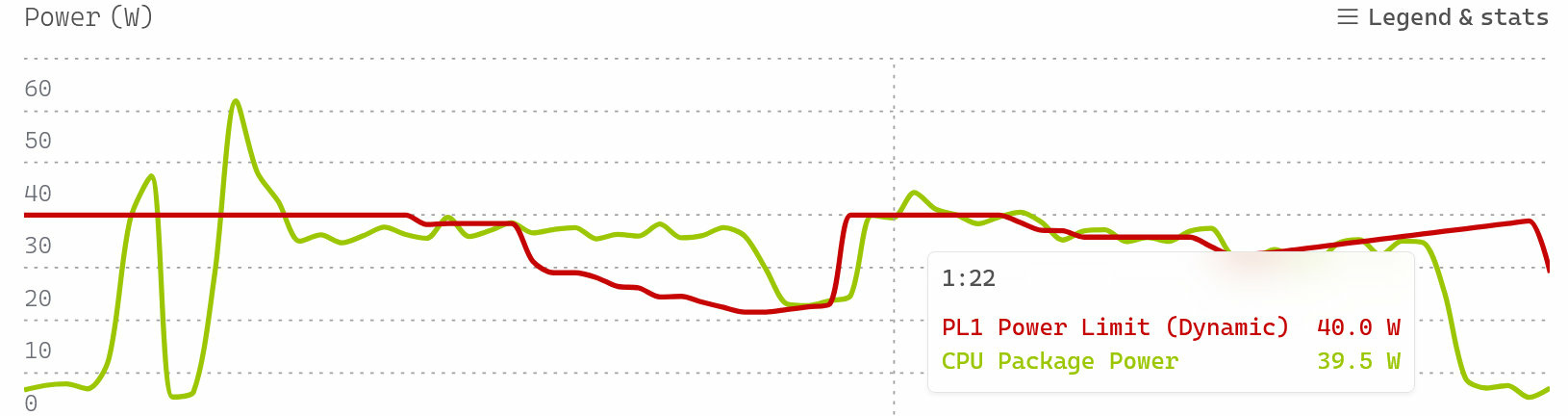
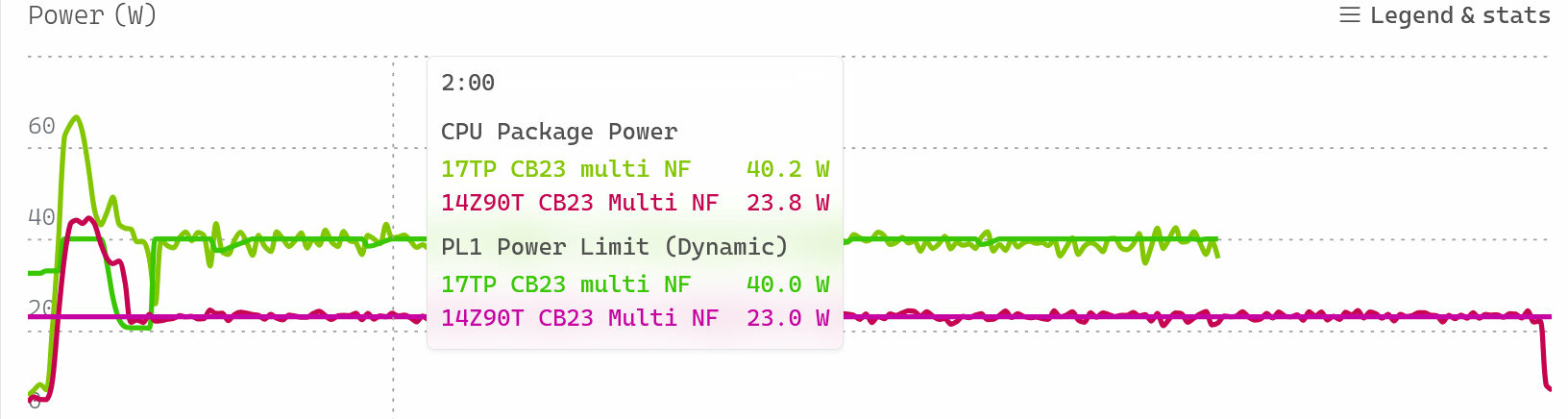
Here are a couple of power graphs created by Log Visualizer using HWiNFO loging data. They use the Normal fan speed setting. The first is running the wPrime 1024M test which took just over 2 minutes. The power jumps around but was around 40W for much of the test.
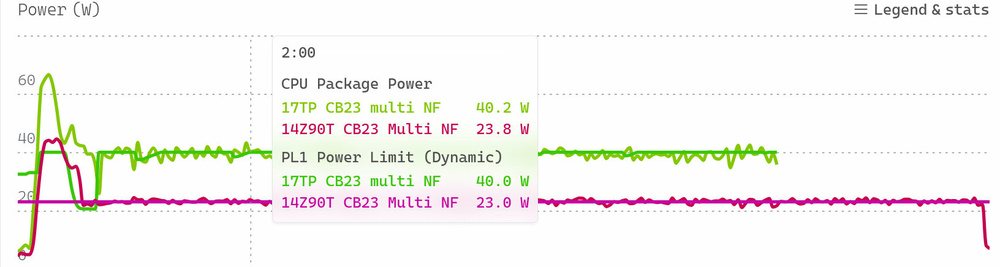
The second is for Cinebench 23 multi where I've plotted the results for both the gram 14 14Z90T and the gram 17 Pro 17Z90TP (I stopped logging before the tests finished). The latter tends to use twice as much power to achieve about a 50% increase in performance due to the CPU needing a higher voltage to maintain stability at higher clock speeds.
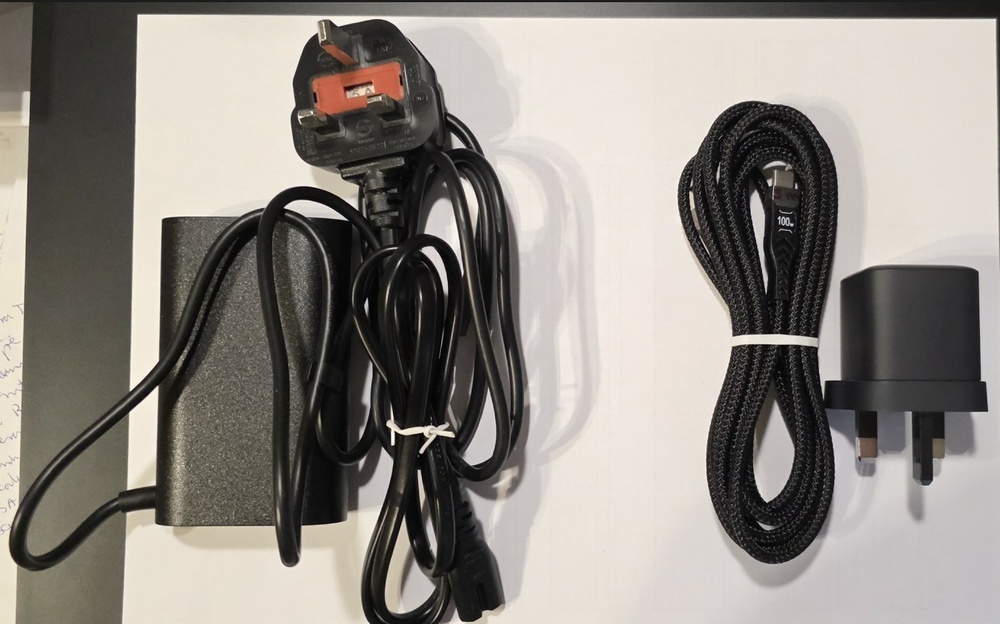
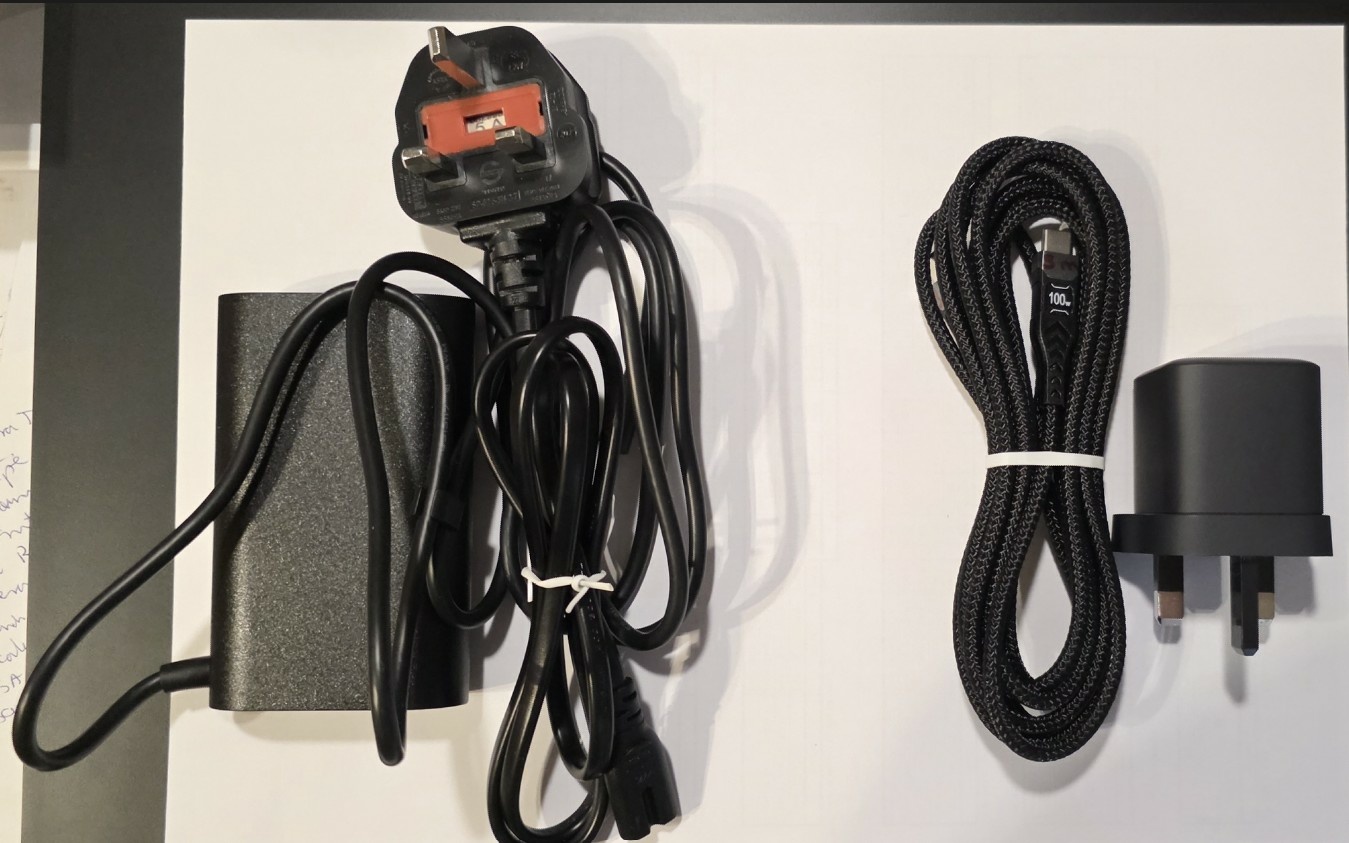
Yes, the massive PSU seems to be a feature of the UK models and perhaps other countries which don't use the US and EU plugs. I have to wonder if LG have a warehouse full of those big PSUs waiting to be used up. For alternatives, anything which supports 20V seems to be a safe bet while I've just found that a Samsung 25W phone charger which doesn't support 20V but does support PD0 and PPS also works. A charger with more than one output may or may not work depending if anything else is plugged in. Some are set up to provide the same voltage at all the outputs, others power each output separately.
-
The same pattern of the 2025 gram Pro on low fan being faster than the 2024 gram Pro on normal fan is also seen on the Passmark benchmark test.

Finally, I ran some 3D Mark tests although I don’t normally have a need for 3D graphics. The results follow the trend of the 2025 gram Pro on the low fan setting being faster than the 2024 gram Pro using the normal fan setting.

I carried out some battery testing using my normal method of playing an MP4 movie. At 60% display brightness the average power drain over 8 hours was 5.3W. Lowering the brightness to 35% reduced the power drain to 4.4W. Illuminating that big display is what uses the lower. I have little doubt that the computer is capable of spending a working day of normal office usage without needing a power socket. It can’t match, however, the 14” gram where the power drain for the same test is less than 3W but higher CPU usage will have a bigger proportional effect on the latter machine.
While talking of power, LG ships the UK models of its notebooks with a power brick which has a separate mains cable which adds a lot to the travel weight. The computer will, however, work off almost USB-C PSU which has a 20V output. It will complain if the PSU rating is less than 65W but this has no adverse effect on performance. If needed, some power will be taken from the battery. The photo below compares the LG 65W PSU with an Anker 65W PSU plus 3m USB-C cable.
In conclusion, it appears that my objective of having a notebook similar to my 17” 2024 gram Pro which can match its performance but with less fan noise is satisfied by the 2025 version. Perhaps the Panther Lake 2026 gram Pro will be even better but it might also be more expensive.
-
For performance testing I started with the old and simple wPrime for which I have results going back many years and which measures the basic CPU performance. The 32M tests, which only last a few seconds on modern hardware, don’t vary much. Two outliers on the 1024M test are the 17Z90T with its poor design of the cooling vents and the 2024 gram Pro on the low fan (and low power) setting. The 2025 gram Pro on low fan isn’t far behind the 14” gram or the 2024 gram Pro running at the normal fan setting. LG seem to have selected a good power value for this low fan setting while there’s marginal performance gain in return for the much greater noise of the high fan setting.

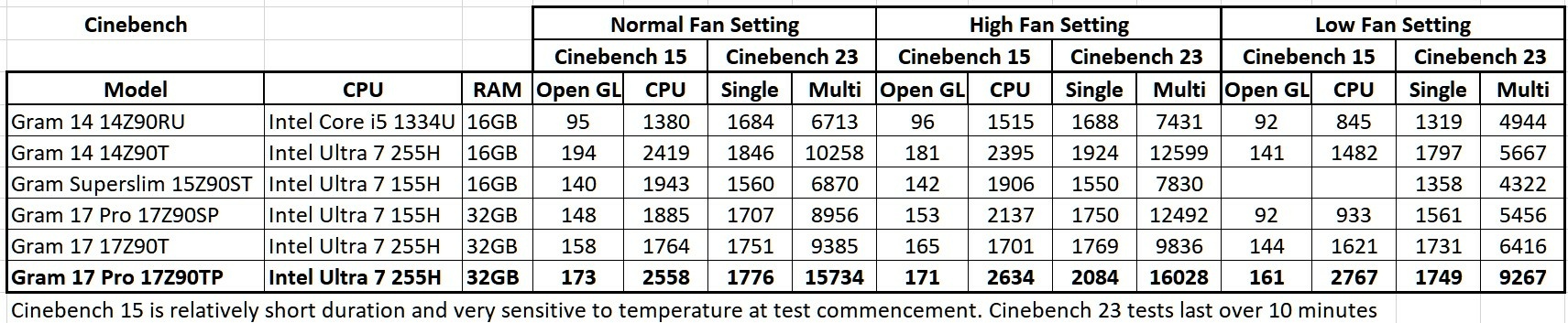
The next benchmark to be examined is Cinebench. The older Cinebench 15 tests are completed relatively quickly on newer computers but are representative of short duration tasks. Cinebench 23 keeps running for at least 10 minute and is a better indication of thermal performance limits during longer duration tasks.
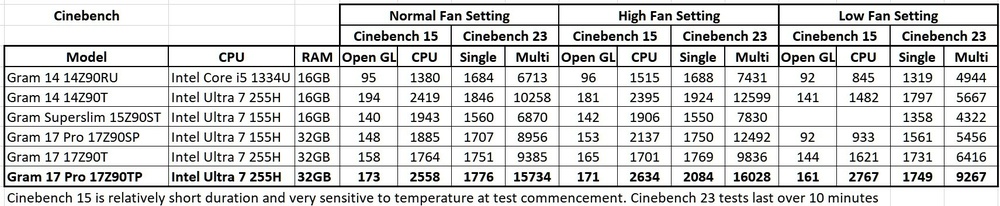
There’s not much difference in the Cinebench 15 results for the Arrow Lake 14” gram and 17” gram Pro while both are well ahead of the non-Pro gram 17. There’s also not much difference in the single core performance of any of the notebooks in my summary table. In fact, the 14” gram leads the field for this test. I suspect that this is due to the lower power limit keeping the CPU running faster for more time before reaching a thermal limit which triggers a slowdown. In Cinebench 23 the same pattern is noticeable for the single core test but the 17Z90TP is well ahead of the others for the multi-core test. On the low fan setting it’s faster than the 2024 gram Pro at the normal fan setting.
The next set of tests is Geekbench 6 where the single core test results are all close together with the 14” Arrow Lake gram being slightly faster than the 17” gram Pro for the same cooling option. The 17” Arrow Lake gram Pro pulls ahead on the multi core tests and also on the graphics tests, perhaps helped by more and faster RAM. This notebook, on the low fan setting is faster than its predecessor at the normal fan setting. More speed with less noise!

-
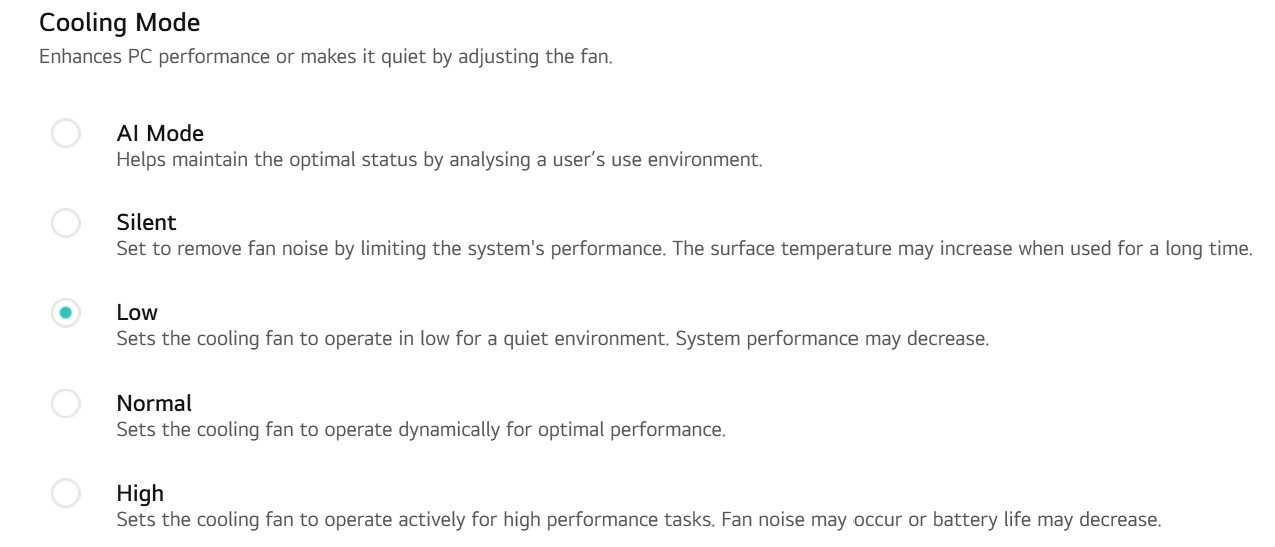
It's time to do some testing which is made more complicated because the user-selected fan speed controls the CPU performance in longer tests. LG’s design logic is to specify different power limits in the BIOS according to the cooling mode option selected by the user using either the LG “My gram” app or the Fn+F7 key combination.
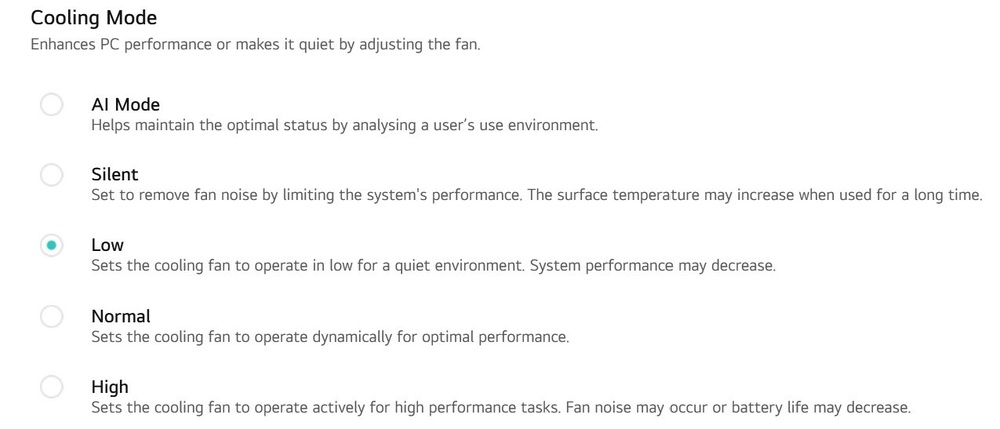
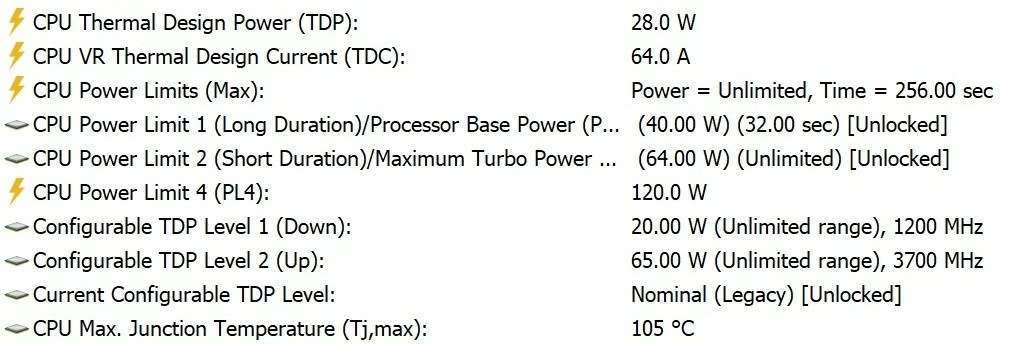
The system has two power limit values. PL1 is the maximum long duration power which can be supplied to the CPU and PL2 is the short duration power limit. HWiNFO reports this information for the Intel 255H CPU:
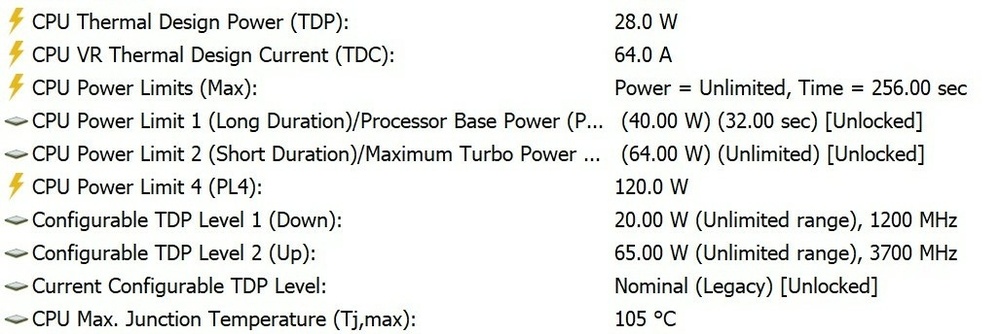
Those are the static (ie base value) power limits which LG designers considered appropriate for the notebook’s thermal performance. There are also dynamic power limits which change according to the cooling mode and can be seen using HWiNFO’s sensor data. I have summarised these and compared them with the corresponding values for some other LG notebooks. I have ignored the AI cooling mode because one initial test showed slower than the low fan setting. Perhaps it measures the ambient noise.

It can be seen that LG have given the 2025 gram Pro higher PL1 values than both its predecessor and the other 2025 models with the same CPU. The difference on the low fan setting is substantial. More power should enable higher performance until the CPU reaches the maximum allowable temperature of 105°C.
-
First an explanatory note about model numbers. LG has used a fairly consistent system for model numbers which is used here for brevity. The model being reviewed is 17Z90TP. The 17 is for screen size, Z seems to be Intel clamshell (but so is U, while T is two-in-one), I haven’t figured out 90, T is the model year 2025 or perhaps the hardware generation as LG also released some RU models in 2025 with 2023 Intel hardware, the P is an optional extra letter which indicates the Pro versions (some 2025 models also have L versions with Lunar Lake chips). My 2024 gram Pro is model 17Z90SP.
I already owned the 2024 17” gram Pro (and before that the 2022 17” gram). The notebook normally serves as a compact desktop computer. I like the 17” screen size without the bulk of most 17” notebooks (usually gaming machines) but with the capacity to hold two SSDs. LG’s 17” IPS panel is very good quality. The main limitation of LG’s slim format is the cooling system. This was partly addressed by the introduction of two fans in the 2024 gram Pro which had a noticeable performance improvement compared to the 2022 model, but two fans can make more noise than one.
In December 2025 I bought the 14” LG 14Z90T and was impressed that it could perform as well as my 2024 17Z90SP despite the latter’s two fans (see this mini review). I like my notebooks to be both efficient and quiet and I therefore tried the 2025 17” gram (17Z90T) which had the same internal hardware (except for 32GB RAM instead of 16GB) as the 14” but discovered that it under-performed (see my comments here). It was returned for a refund. Since then I’ve been watching out for a 32GB version of the Pro model (ie two fans) of the 2025 17” gram at a reasonable price and found one which had been returned to Amazon UK. I quickly discovered that this 17Z90TP performed more in line with my expectations.
This notebook is model 17Z90TP-G.AD88A1 which has the Arrow Lake Intel® Core™ Ultra7 255H CPU, Intel® Arc™ graphics, 32GB of 8,400MHz RAM, a 1TB SSD and a 17” WQXGA (2560 x 1600) IPS display. The weight, according to my digital scales, is 1.326kg which is slightly lower than the advertised 1.369kg but more than the 1.277kg that I measured for the 2024 gram Pro. I won’t go into all the details as much is the same as the 2024 model. My interest is in the performance difference.
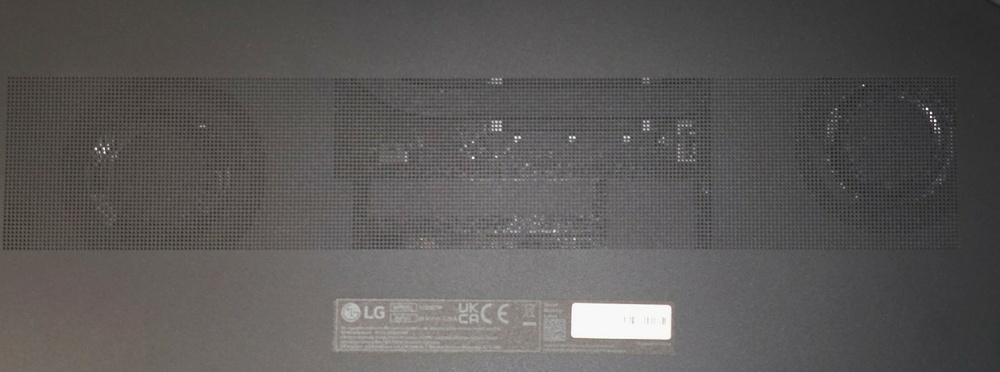
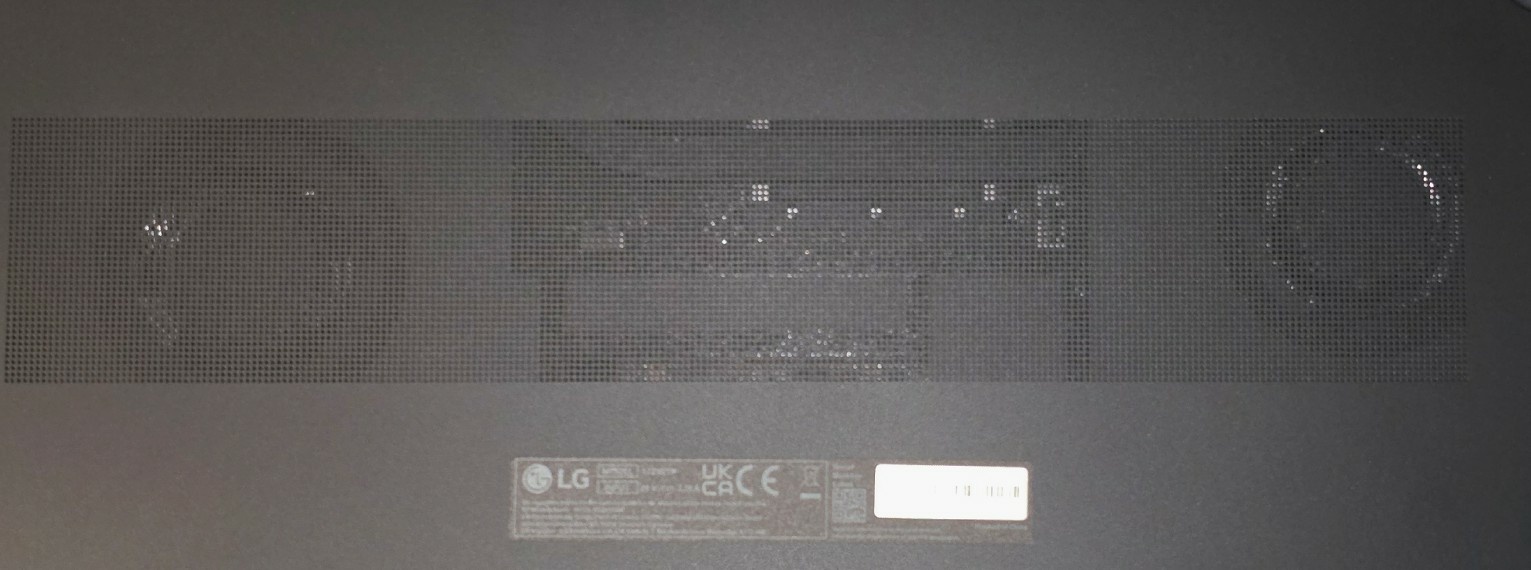
Externally the gram 17Z90TP looks the same as the 17Z90SP. There are different stickers on the palm rest and the right Ctrl key on the keyboard has been replaced by a Copilot key. The display is the same top quality matte LG IPS panel. I could see that, unlike on the non-Pro gram 17, the vent holes in the bottom matched the fans:
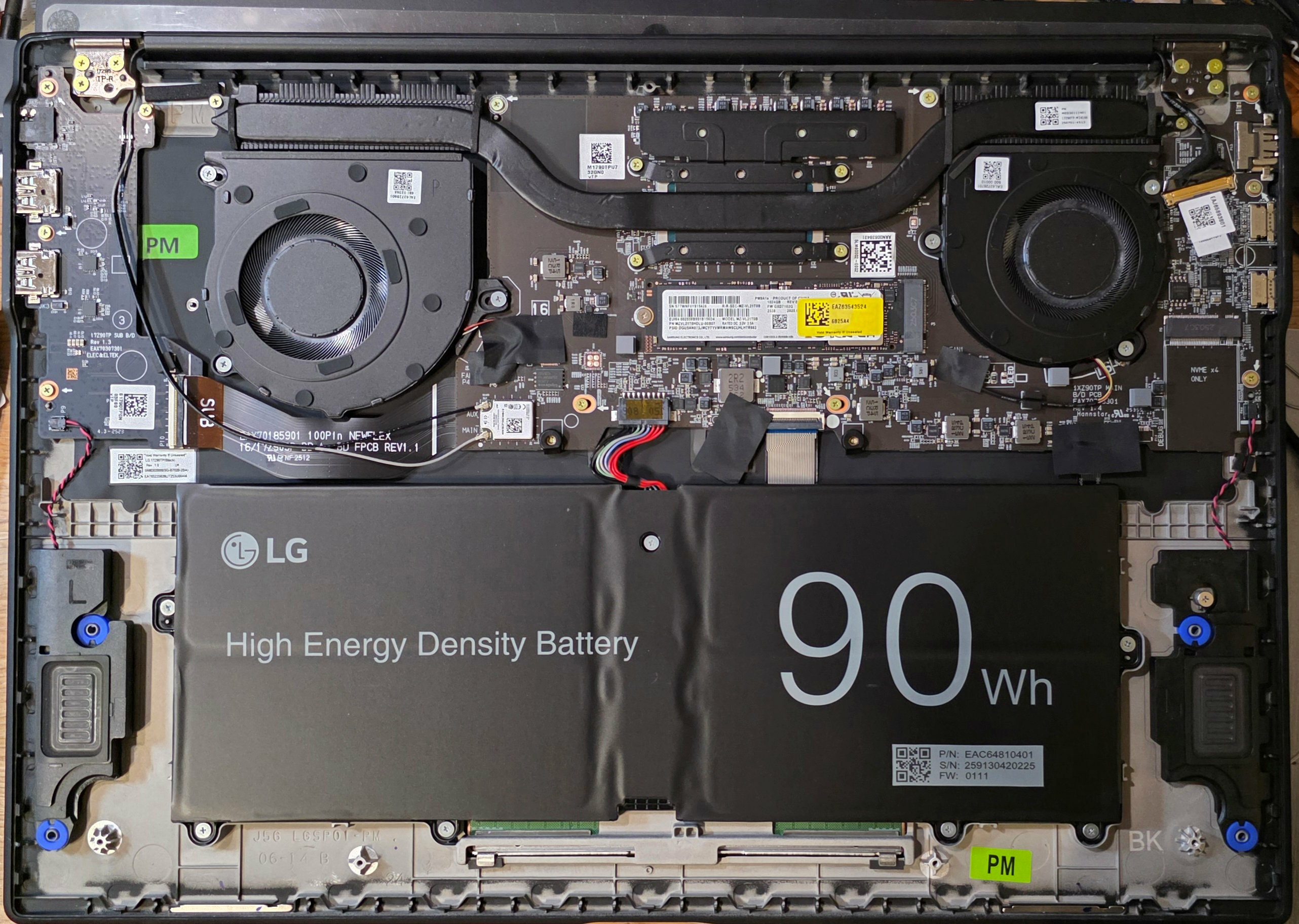
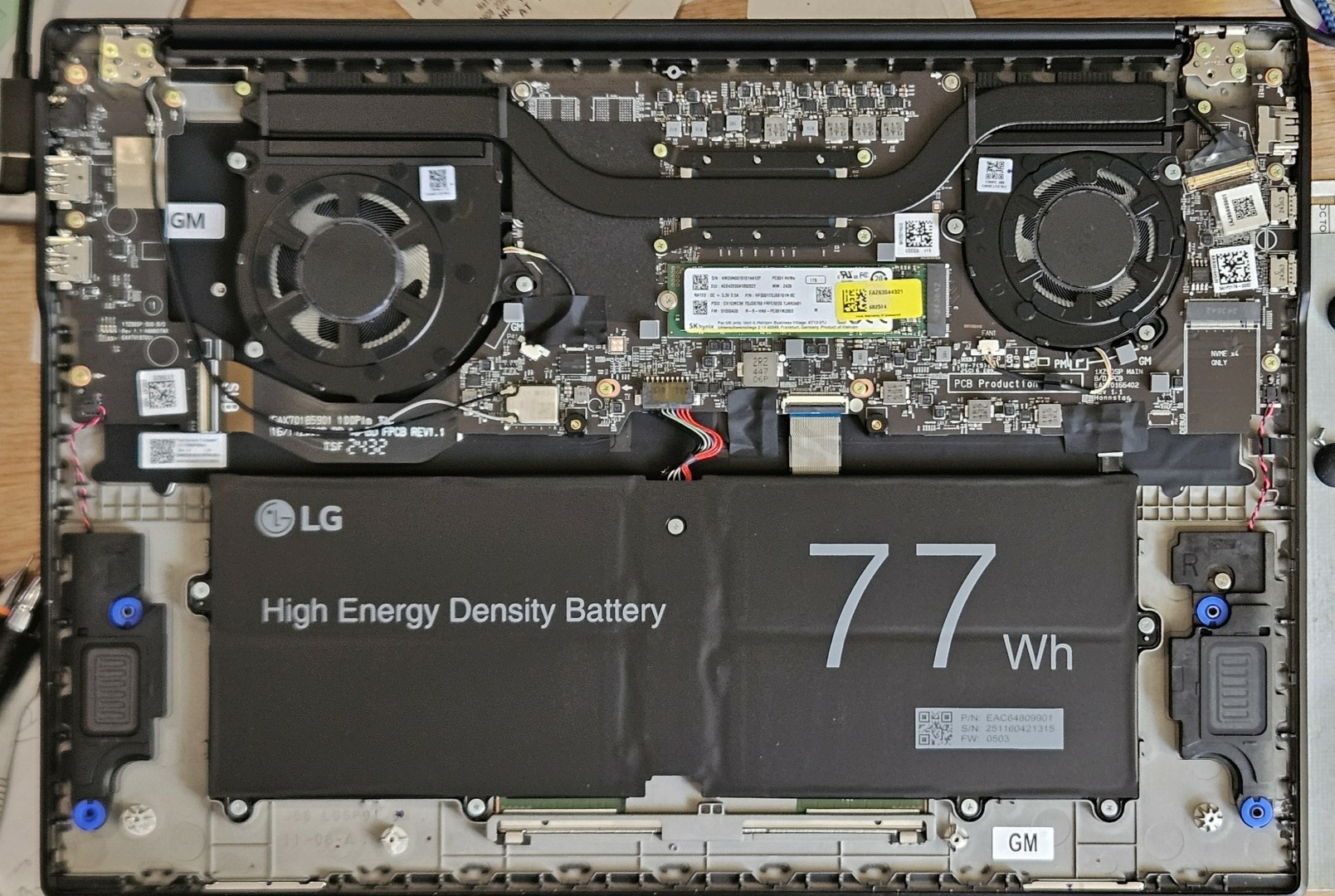
Getting the bottom off the gram Pro is relatively easy: Remove the four rubber feet, remove four screws and then carefully prise off the base (the non-Pro gram 17 uses a different design with more screws). Internally there is the same overall layout. The fans look different but have similar size and the heat sink in the newer gram also covers the memory chips which are rated at 8.4GHz. The 90Whr battery in the newer gram Pro is the same physical size as the older 77Whr battery. Above is the 2025 gram Pro, below is the 2024 gram Pro.
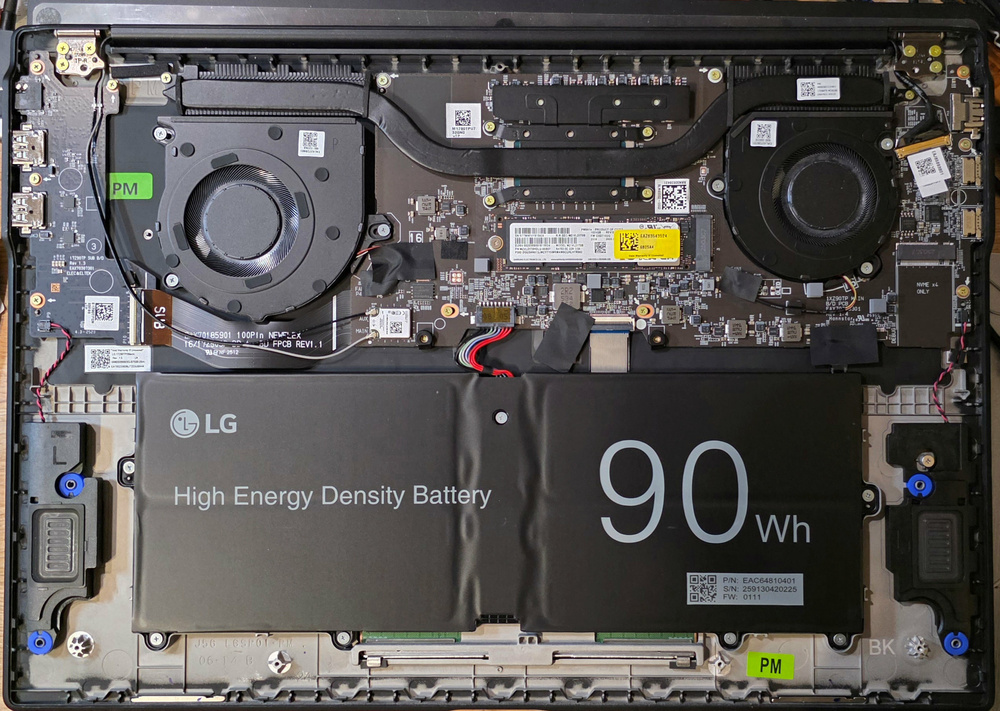
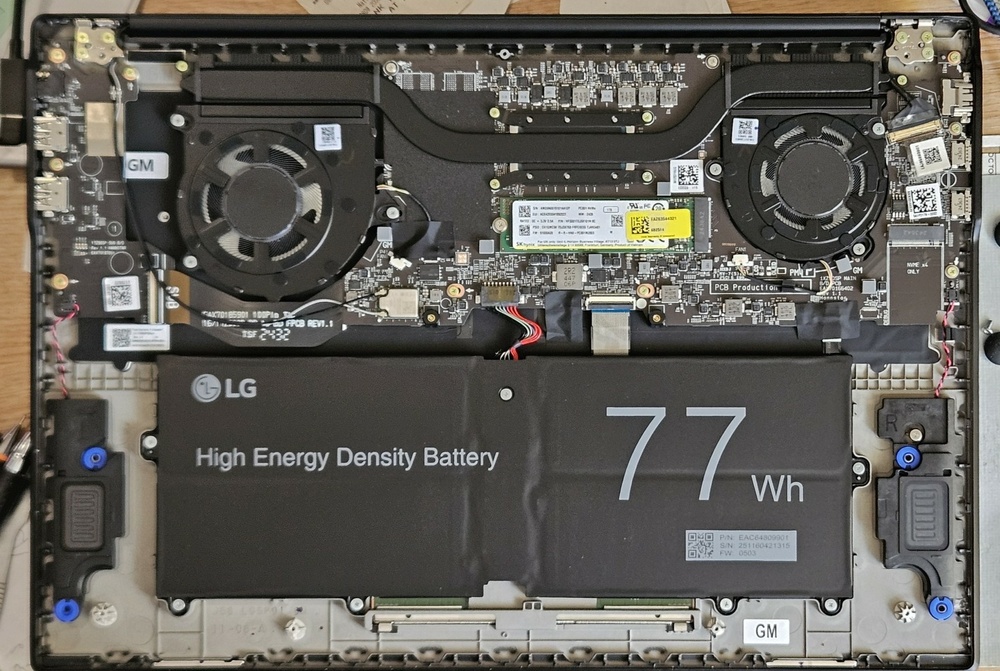
The 90Whr battery was an unexpected bonus as the LG UK specs, replicated by the retailers, say 77Whr. The LG global specs for this model might be the cause of the confusion as they show 77Whr in the summary and 90Whr in the detailed specs. It seems that no one checked. 90Whr, however, is standard for the version of the 17“ gram Pro with the Nvidia GPU.
-
Notebook check has posted a review of the 15.6" 15U55T. The reviewer has commented on the relatively low fan noise but I can't see any comment suggesting that they tried the different cooling mode options which would affect the performance.
-
Yes, the fans in my 2025 17" gram Pro look like those. I'm also wondering how much the air flow is restricted by the small gap (about 3mm at the back) between the bottom of the notebook and the surface that it is resting on. I've got some 5mm thick rubber pads waiting to be fitted at the back of the new machine. I don't have the dual speakers.
-
I'll put an internal photo with the fans in my mini-review.
I use HWiNFO to see a lot of performance data (below is an extract from the long list of values).
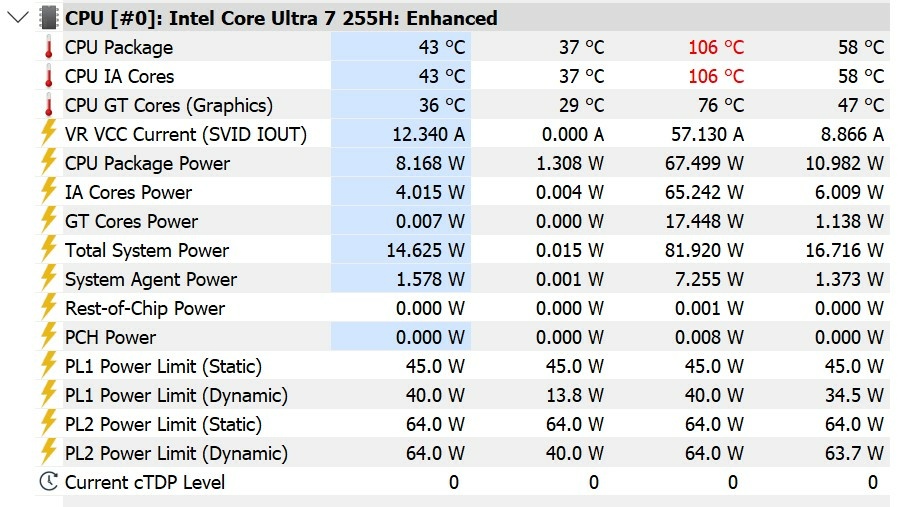
The PL1 dynamic value changes immediately when I change the fan speed (note that I have not investigated the BIOS settings or installed any other power management tools. What I would like is a slightly lower normal fan speed setting with correspondingly lower power limit but I've not seen any option for fine-tuning fan speed in the advanced BIOS when previously looking at the options.
-
My 2025 gram 17 Pro (model 17Z90TP-G.AD88A1) won't be going back. It is altogether a much better thermally designed version of the gram 17 than the non-Pro machine which was a disappointment (see my post here) to the extent that I wonder if LG deliberately crippled it in order to encourage people to buy the more expensive version. I also discovered that this model has the 90Whr battery in spite of most specs saying it has a 77Whr battery. The original source of this mininformation is probably this LG global listing which states 77Whr in the summary spec but shows 90Whr in the detailed specs.
I will start by providing this table showing the design power limits which programmed into the BIOS (I didn't realise the significance of this information until after I had sent the 17Z90T back so I've only got the power limits for the normal fan setting for that machine). The power limits reflect the designers' estimates of the heat disssipation of a notebook's cooling system for a particular maximum fan speed. However, it seems that some designers have done a better job than others as the 14Z90T out-performs the 17Z90T despite having lower power limits.

The difference in the power limits between the 2024 gram Pro (17Z90SP) and the 2025 gram Pro (17Z90TP) is noticeable. The fans look better in the newer model. However, subjectively, I also feel that the newer model is also noisier on the normal and high fan settings although using my phone as a sound meter doesn't reveal a significant difference in sound volume. I think the newer model's fan noise is higher frequency.
Where the 17Z90TP really scores, however, is the performance at the low fan setting where overall performance is similar to the 17Z90SP at the normal fan setting and the low fan is barely audible so I'm planning to forego some performance in favour of having a quieter computer. That performance hit depends on what is happening. The difference in the Passmark score is minimal while it's big for the Cinebench 23 multi-core test.
Once I've sorted out my test results I'm going to put the details in a separate mini-review thread for the 2025 gram 17 Pro.
-
I've just pressed the buy button on a returned Gram 17 Pro at Amazon UK which was almost 25% off the current inflated price and slightly below the brand new price of two months ago. There was an even cheaper returned model a few weeks ago but I was away on holiday. I will be checking if this two fan gram 17 can match the performance and quietness of my gram 14 with the same 255H CPU. The single fan gram 17 failed this test and was returned to LG (a slow process but I got my money back).
-
I didn't notice a significant difference in display quality between the IPS panel on my 17" 2024 gram Pro and the 15.5" OLED panel on the LG gram Superslim.
I will be watching the prices of the Panther Lake models with interest. I feel that notebook manufacturers will have to absorb part of the higher RAM cost if they want to sell the 2026 products. For most users the improvements offered by the new models aren't sufficient to pay a big price premium.
-
On 2/12/2026 at 9:20 PM, extremecarver said:
Edit: it's a mess. I simply don't find out what I did initially to have unlimited power. And bios load default is not fully resetting all of the hidden options, seems they are not part of the default. the best I get is 30w constant and before a 28seconds 45w window.
You have been very adventurous with your changing of the advanced BIOS setting than I would consider doing.
Amazon UK has followed LG UK with big price increases on the 2025 models but I'm waiting to see if one which is returned is offered at a tempting discount.
-
Regarding your original starting question for this thread about the LG My gram software, I've not yet noticed any significant difference in power usage when My gram's battery saving mode is enabled. There would need to be long tests under controlled conditions to see if there is any overall difference and also figure out whether LG has done more than is offered by the standard Windows power options. I get the impression that the Intel Arrow Lake / Lunar Lake package (with some parts made by TSMC) provides a welcome improvement in power efficiency under light usage conditions.
Overall, I'm not impressed by the user interface of the My gram software which brings all the LG controls into one place.
-
On 2/6/2026 at 8:13 PM, extremecarver said:
Edit: so it worked to just plug in my old harddrive. Steps to do: 1. you need a USB mouse. 2. Change boot order and move old disk to spot 1 in bios, best remove fingerpring login and any other login before moving the drive - else you will need to cut power three times while booting to get into boot option, boot in safe mode with networking - change a registry setting, reboot, use the physical mouse to click on other sign in option and select password... Then install the new LG updater for the current model (the old program is useless now) - install all updates. 5. Make sure under settings --> apps --> optional features --> to install windows hello facial --> reboot plently of times and run windows update --> after 3 hours everything was working without fresh windows installation. Power options were messed up again - so need to set in registry all the options especially AHCI link and again select lowest - as otherwise it defaults once again to HIPM only. Last step - get a new windows license used and activate windows.
Somehow you will need to login back to many places - and still reactivate the 2nd factor authentication from fingerprint now to facial. For me that still saves plenty of hours vs a fresh installation of windows 11 madness.
This is something I would like to be able to do if I change computer. Do you have any software with a single licence which needed to be transferred? If so, did you release the licence before moving the SSD and then reapply? The need to do this probably depends on what hardware fingerprint the licence system uses.
On 2/7/2026 at 8:00 PM, extremecarver said:After repasting I now get constant fully loaded power use slightly above 40watts. Huge change. LG had put enourmous amount of paste onto the CPU. Now good point about that way is - it will never pump out as much as they put, bad think is performance. I went with Durnaut by Thermal Grizzly as this is considered to be the most durable paste on the market right now (except some funky Chinese ones where however you never know if you get what you order...) with great performance.
How much fan noise are you getting at 40W? I want good performance with minimal noise.
LG refunded my money for the Arrow Lake gram 17 (not Pro version) and I'm wondering what to do next. (i) Get the gram 17 Pro if the price is right; or (ii) get the Nvidia version which is known to have a better cooling system (but this is likely to have a substantial price premium); or (iii) get another non-Pro gram 17 if at a good price and modify the air vents for the fan plus the power limits; or (iv) wait for the Panther Lake models to first appear and then be discounted. LG seem to have had some muddled thinking while configuring for both Arrow Lake and Lunar Lake.
I'm currently away from home at the moment so thinking and watching the prices.
-
On 2/8/2026 at 11:41 PM, extremecarver said:
Why is the dynamic power limit so low? With that amount of power it will not even best a lunar lake at 40w with much more cores.
Is it one fan only? Even then I think you could increase it by 50%. I think it's only needed to set overclocking lock to no then afterwards it's unlocked in throttlestop.
With two fans could outright double PL1.
This is the 14" gram so no room for two fans. The dynamic power limits are changed in response to the chosen fan noise setting. I'm a little puzzled why it showed 23W for the PL1 dynamic limit when I captured that dature because it's currently showing only 12W for the normal fan setting and 28W for the high fan setting.
-
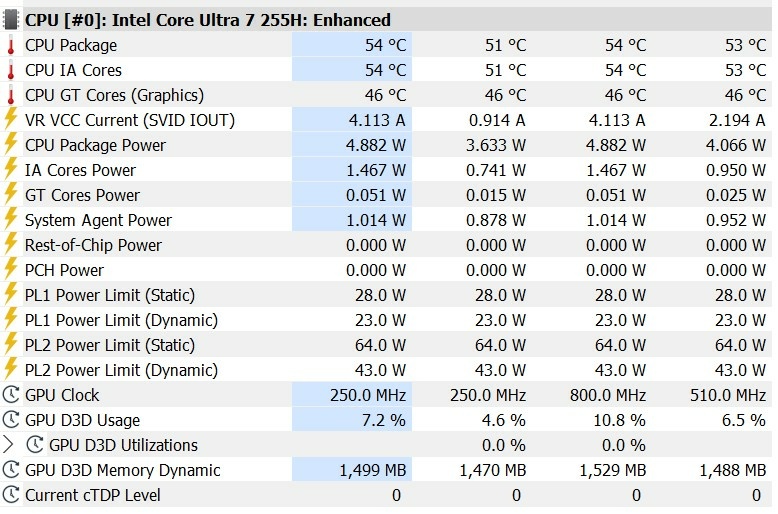
As noted elsewhere, I have been impressed by the overall performance and power efficiency of my Arrow Lake gram 14 and was therefore disappointed by the 17" version of what should be the same hardware couldn't match the performance while making more fan noise. The gram 14T's power limits for the normal fan setting are shown below. These aren't changed when using the battery.
-
7 hours ago, extremecarver said:
Both the new panther lake and AMD have basically zero throttling still pushing 45w into 20 minutes mark. That is pretty impressive so the new fans do work much better.
I wonder what the fan noise is like.
-
I'm a little confused by that video. At about 5 minutes it shows an internal photo labelled 16Z90U with two fans. Later, at about 11 minutes, there is a thermal image which is typical of the one fan configuration. Which version was used for the benchmark testing?
-
On 1/14/2026 at 1:49 PM, skipper said:
And as RS4 already wrote, probably they are killing the non Pro 16-17 versions, which was about time because their one fan thermal throttling was only causing dissatisfied customers.
My gram 14Z90T has shown that it's possible to get good performance with one fan and no excessive noise. It's unclear whether that is by accident or careful design but my quick look at a gram 17Z90T revealed that is easy to get things wrong. One mystery is why this Lunar Lake non-Pro gram 16 has two fans but was quite noisy when stressed. Are different teams not talking to each other or is there deliberate experimenting?
-
The memory manufacturers won't suffer so much if the AI bubble bursts because they are avoiding ramping up production (which takes several years) in response to the current high demand. Their profits will suffer if there's a downturn but not as badly as if they were heavily investing in more production. They've been there before.
-
5 hours ago, extremecarver said:
Can you not change the power limits in advanced bios anymore or with throttlestop?
I've just checked (advanced BIOS is still Shift+Ctrl+Alt+F7) and the power limits are locked. It's possible that changing some other setting might unlock them. There are also custom TDP options but I'm not going to try to understand them.
.thumb.jpg.0fa21289b380f61957d96fe6f3e7df73.jpg)






.jpg.d0a3f1f711d0cbb4803700db02fd1eb8.jpg)
LG gram Pro 17 17Z90TP performance evaluation
in LG
Posted
Thanks. I was aware of sfc but wasn't aware of dsim which spent a long time at 62.3% which, the internet tells me, meant it was downloading an update. The computer has now successfully been through the full virus scan. More worrying, however, was an unexpected shutdown yesterday when I left the computer for a a couple of hours. It should have been sleeping but was off when I returned. The system log shows nothing helpful so I wait to see if it was a one-off incident.