
Khenglish
-
Posts
46 -
Joined
-
Last visited
-
Days Won
1
Content Type
Profiles
Forums
Events
Everything posted by Khenglish
-
Your card has broken solder connections between the core and vram. It either needs to be repaired or replaced.
-
Nvidia-vBIOS-Clock-Power-Tweaker - PASCAL TESTING NEEDED !
Khenglish replied to JadeRover's topic in Components & Upgrades
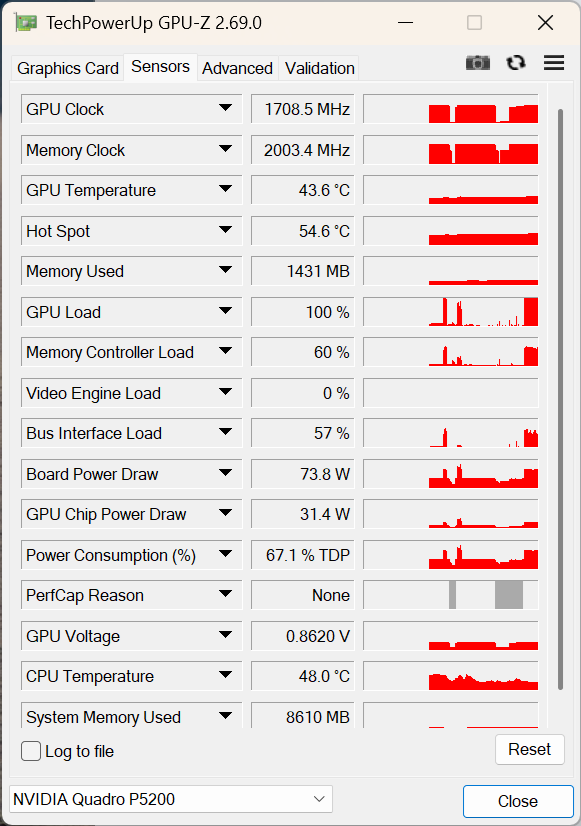
Did you get higher performance out of this vbios? For me higher clocks would be reported, but it seems like it never actually ran at those clocks. The card always performs like it is running at 1695.5 -
Does an external display work after installing a driver?
-
Nvidia-vBIOS-Clock-Power-Tweaker - PASCAL TESTING NEEDED !
Khenglish replied to JadeRover's topic in Components & Upgrades
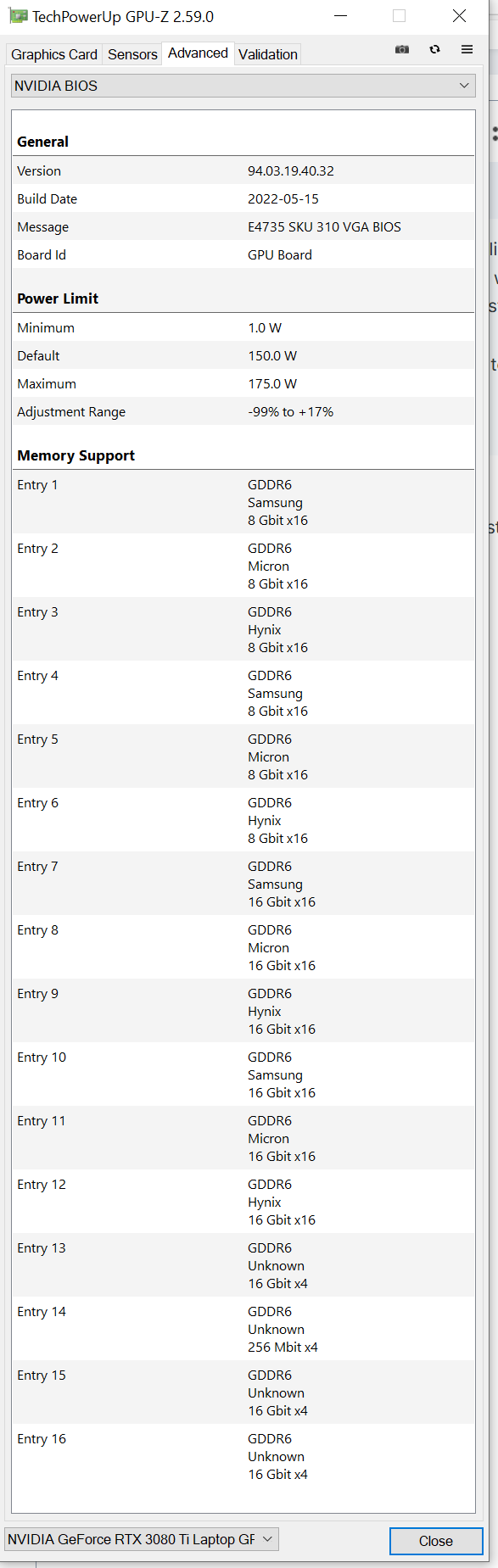
Interesting. My lenovo system recognizes the card with that vbios while the Clevo does not. It does boost up to 1911, but the power limit is not behaving right. I'm hitting the power limit at around 120W, even at the stock 150W, or if I raise it to 175W. I tried 8GHz RAM on that which worked. Trying 9GHz and 8.5GHz got me locked to 6GHz though. GPUz would report the set overclock as the default clock, but it would actually run 6Ghz. Overall perf is worse on this even with 8GHz ram. Clock offsets would be fun if you could get that to work. -
Nvidia-vBIOS-Clock-Power-Tweaker - PASCAL TESTING NEEDED !
Khenglish replied to JadeRover's topic in Components & Upgrades
One possibility to get around vbios overclocking locks might be if we could get device ID modding to work. The P5000 is the same 16GB memory config as the P5200, so that could be used as a base. I wonder if the older P4000 and P5000 vbios aren't as locked down as the later P5200 vbios. -
Nvidia-vBIOS-Clock-Power-Tweaker - PASCAL TESTING NEEDED !
Khenglish replied to JadeRover's topic in Components & Upgrades
Yeah anything 4004 or higher sets 8GHz ram as long as a I don't touch the base or boost clocks. 6GHz if I touch those. I also tried again to mod the P4000 device ID to be a P5200. That failed again. There seems to be some security check beyond checksums to check the device ID. Also, I tried 10GHz again, but it just ran 8GHz. My guess is I just got error 43 before due to bad card seating or something, and not due to the card trying 10GHz. I also tried undervolting in hardware since we can't in software. The problem with this is the GPU core still has the same target voltage, so when I supply a lower voltage the on-die droop detectors engage and start clock stretching (This is a frequency loss not reported in software since the GPU is still requesting 1708). I dropped power draw by 10%, but dropped perf 1-4% depending on the test. So really the only way to undervolt without perf loss is bios modding if we could figure out how to mod the VF curve. -
Nvidia-vBIOS-Clock-Power-Tweaker - PASCAL TESTING NEEDED !
Khenglish replied to JadeRover's topic in Components & Upgrades
So for all 3 vbios that work, all 3 can OC memory to 8GHz. I did try one at 10GHz and the card went error 43, implying that it actually was trying to run 10GHz, and failing. Maybe a big VRAM overvolt to 1.65V or something could get 10GHz working, but I think I have a good chance at killing the card trying. I have been trying just adjusting the max clock and not touching base or boost blocks. This seems to permit constant 1708MHz on the core, but no higher. Touching the max clock only does not seem to be wrecking the vram clocks. -
Nvidia-vBIOS-Clock-Power-Tweaker - PASCAL TESTING NEEDED !
Khenglish replied to JadeRover's topic in Components & Upgrades
I tried 9.5GHz (4756 in tool), but that also just resulted in 8GHz. My understanding is 9.5GHz is about the best possible out of GDDR5. I might try 10GHz at some point just to see if it gets set. Yeah modifying core clocks ruins the memory OC and causes 6GHz. I'll try modifying individual clocks to see if one in particular triggers it. -
Nvidia-vBIOS-Clock-Power-Tweaker - PASCAL TESTING NEEDED !
Khenglish replied to JadeRover's topic in Components & Upgrades
I found that your tool can OC the memory to 8GHz. The memory locks to 6GHz if I try modifying core clocks while also overclocking memory. If I don't touch memory at all, then it runs at 7.2GHz even if I adjust the core clocks. I can't get it to try anything faster than 8GHz. I've tried setting up to 9.2GHz, but it still just runs at 8GHz. -
Nvidia-vBIOS-Clock-Power-Tweaker - PASCAL TESTING NEEDED !
Khenglish replied to JadeRover's topic in Components & Upgrades
Interesting that there are 3 locations for memory clocks, but only one needs editing. There are 3 memory options for the p5200. Every p5200 in the world other than mine has option 0 set. On mine I had to set option 2 for 8GB since I core swapped a p5200 onto a p4000 card. Maybe your program is only editing option 0 instead of all 3? I can cycle through the 3 functional base vbios tomorrow. -
Nvidia-vBIOS-Clock-Power-Tweaker - PASCAL TESTING NEEDED !
Khenglish replied to JadeRover's topic in Components & Upgrades
The MSI one failed to overclock though. Still 1709 max. Can we try a 9GHz for the MEM? I tried your tool, but it was reporting 7.2ghz instead of the 8ghz actual. -
Nvidia-vBIOS-Clock-Power-Tweaker - PASCAL TESTING NEEDED !
Khenglish replied to JadeRover's topic in Components & Upgrades
Success!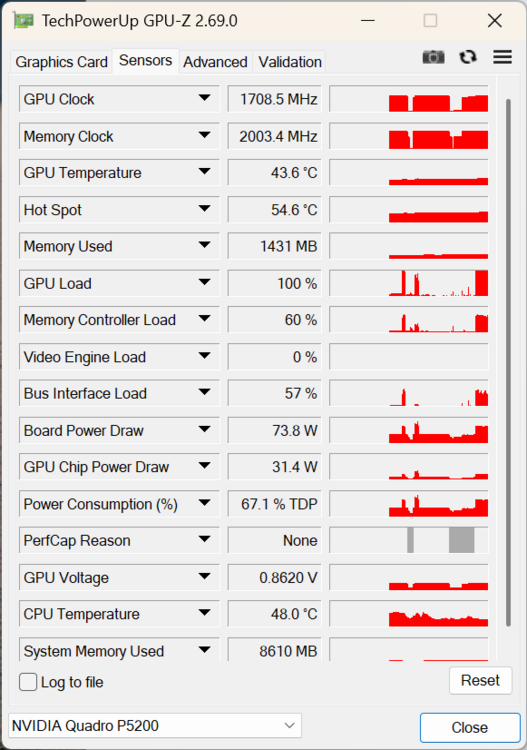
-
Nvidia-vBIOS-Clock-Power-Tweaker - PASCAL TESTING NEEDED !
Khenglish replied to JadeRover's topic in Components & Upgrades
GPU-z always shows 1709 as max boost clocks. For RAM it depends on vbios. For the 3 that work on the card: vbios 1: Will show the overclock, but run at 6ghz. vbios 2: Always shows as 6ghz even unmodded, but will properly run 7.2ghz. It always displays 6ghz and runs at 7.2ghz even if overclock modded. vbios 3: Will both show 6ghz and run at 6ghz if overclocked. If unmodded displays and runs 7.2ghz. I might be mixing this up some, but it's something like the above. The card can only run Dell vbios. MSI and Lenovo both crash on an Nvidia driver. HP does not work at all. The card itself is a Gecube card. I have not found a gecube p5200 vbios. -
Nvidia-vBIOS-Clock-Power-Tweaker - PASCAL TESTING NEEDED !
Khenglish replied to JadeRover's topic in Components & Upgrades
The tool does seem to raise both base and boost clocks correctly, just not the max clocks. Without mods, the card only runs 1709MHz if under 50C. With mods it will maintain 1709 over 50C and just bump the voltage up from 0.85V to 0.862V instead. -
Nvidia-vBIOS-Clock-Power-Tweaker - PASCAL TESTING NEEDED !
Khenglish replied to JadeRover's topic in Components & Upgrades
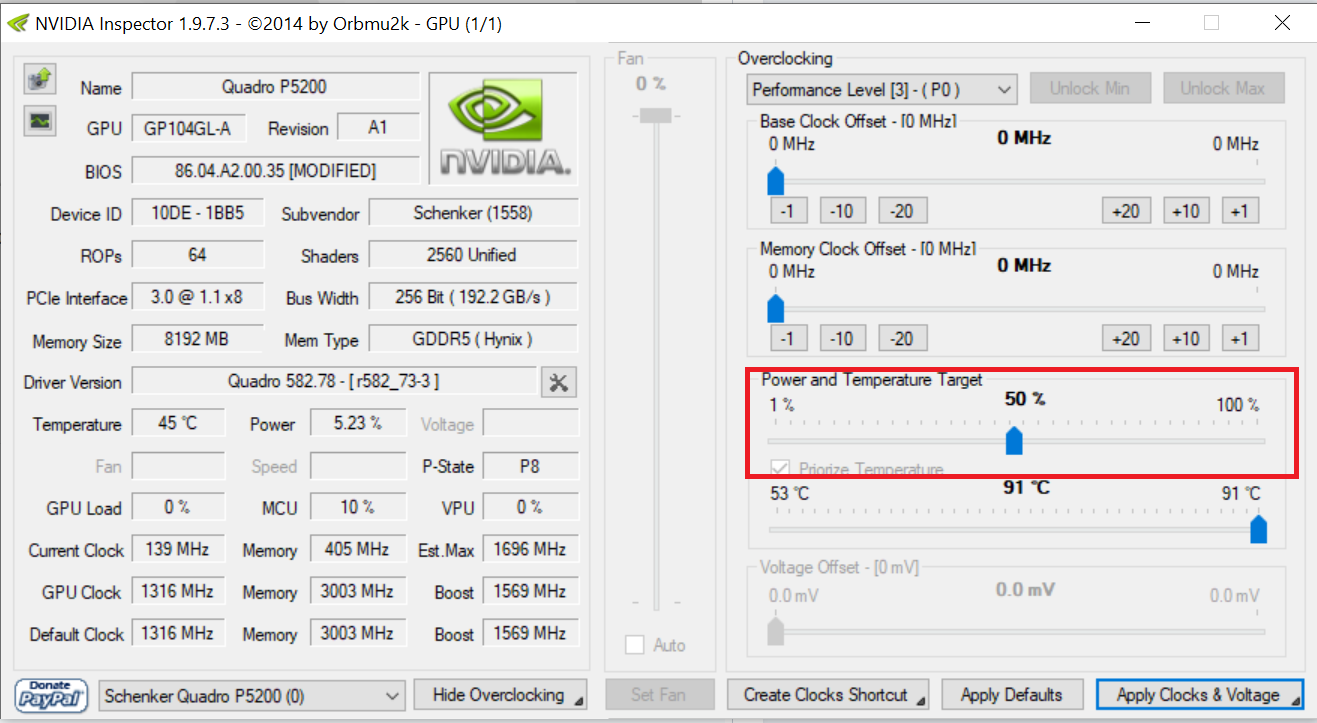
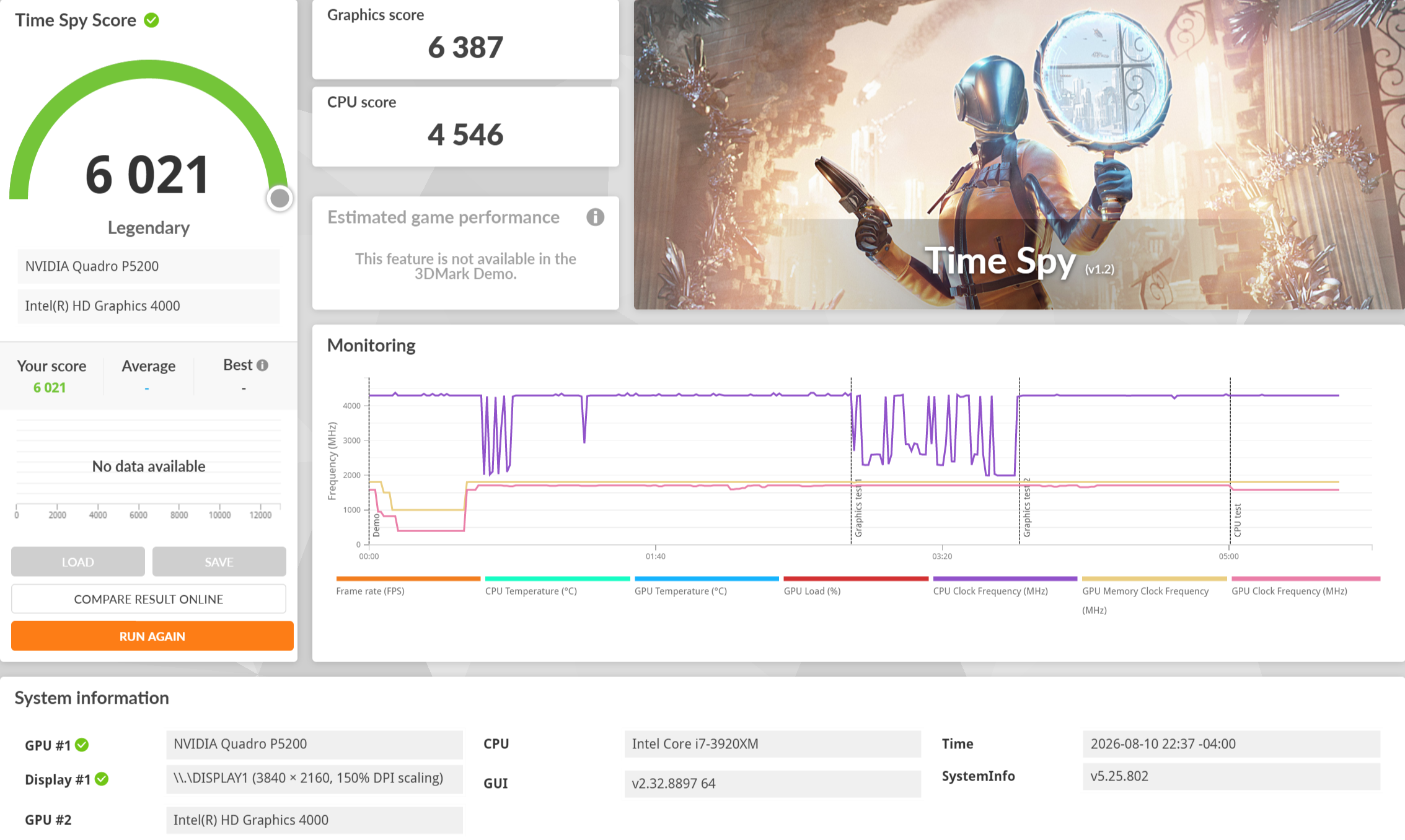
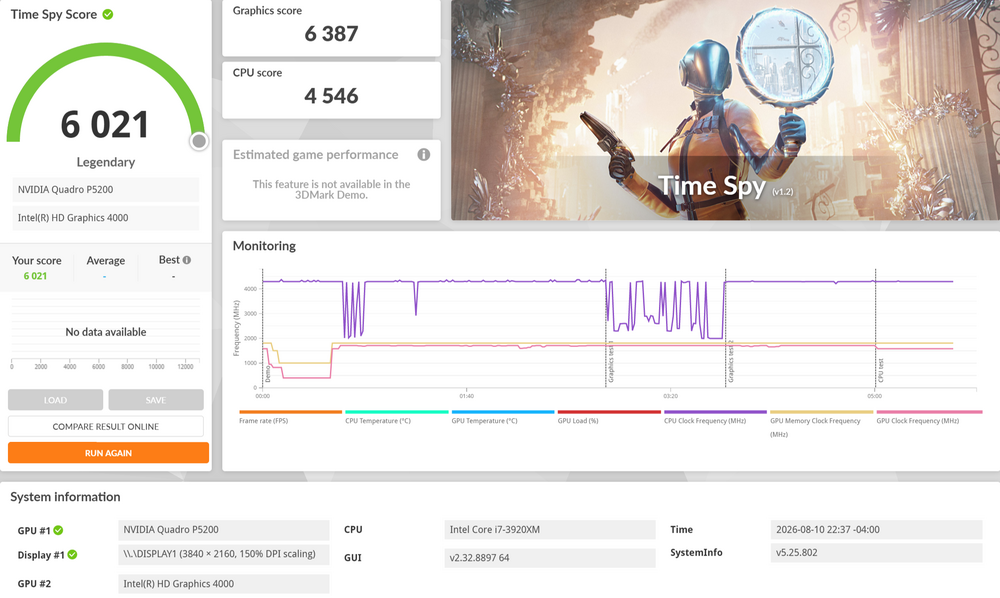
Time Spy with 150W power limit (effectively no limit). Also, the power slider does work. Only Nvidia Inspector (NOT Nvidia Profile Inspector, you need Nvidia Inspector from ~2017) can control it, but it works.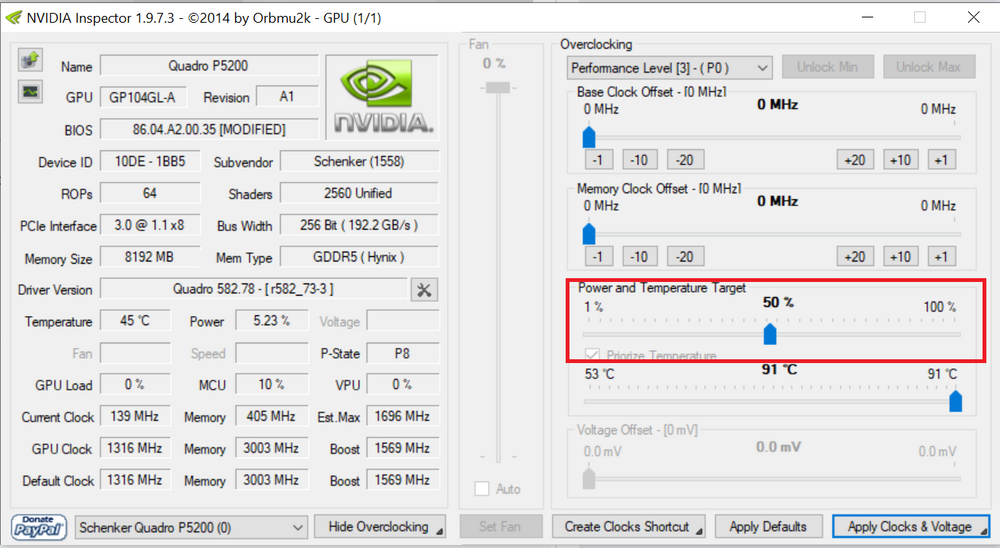
-
Nvidia-vBIOS-Clock-Power-Tweaker - PASCAL TESTING NEEDED !
Khenglish replied to JadeRover's topic in Components & Upgrades
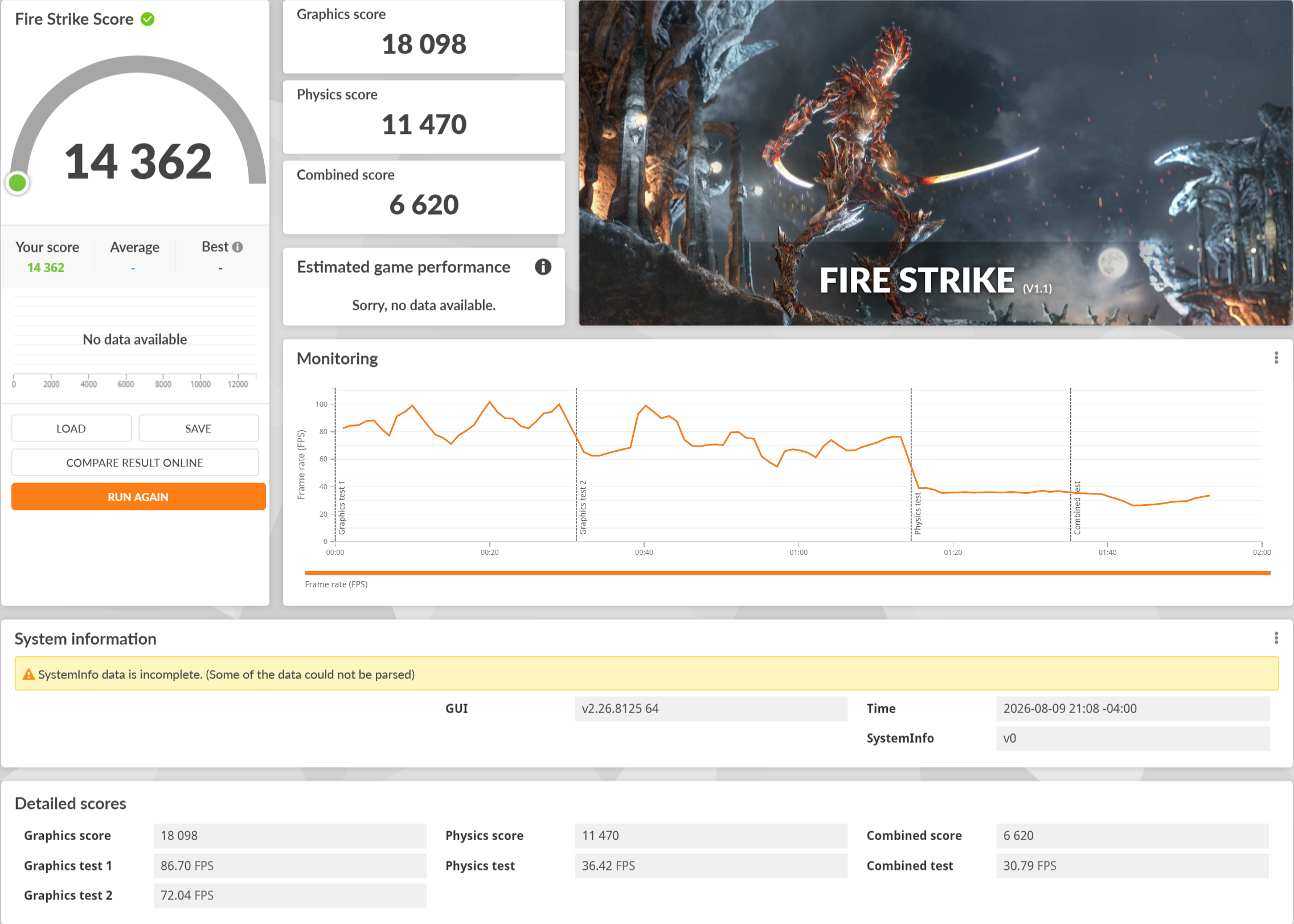
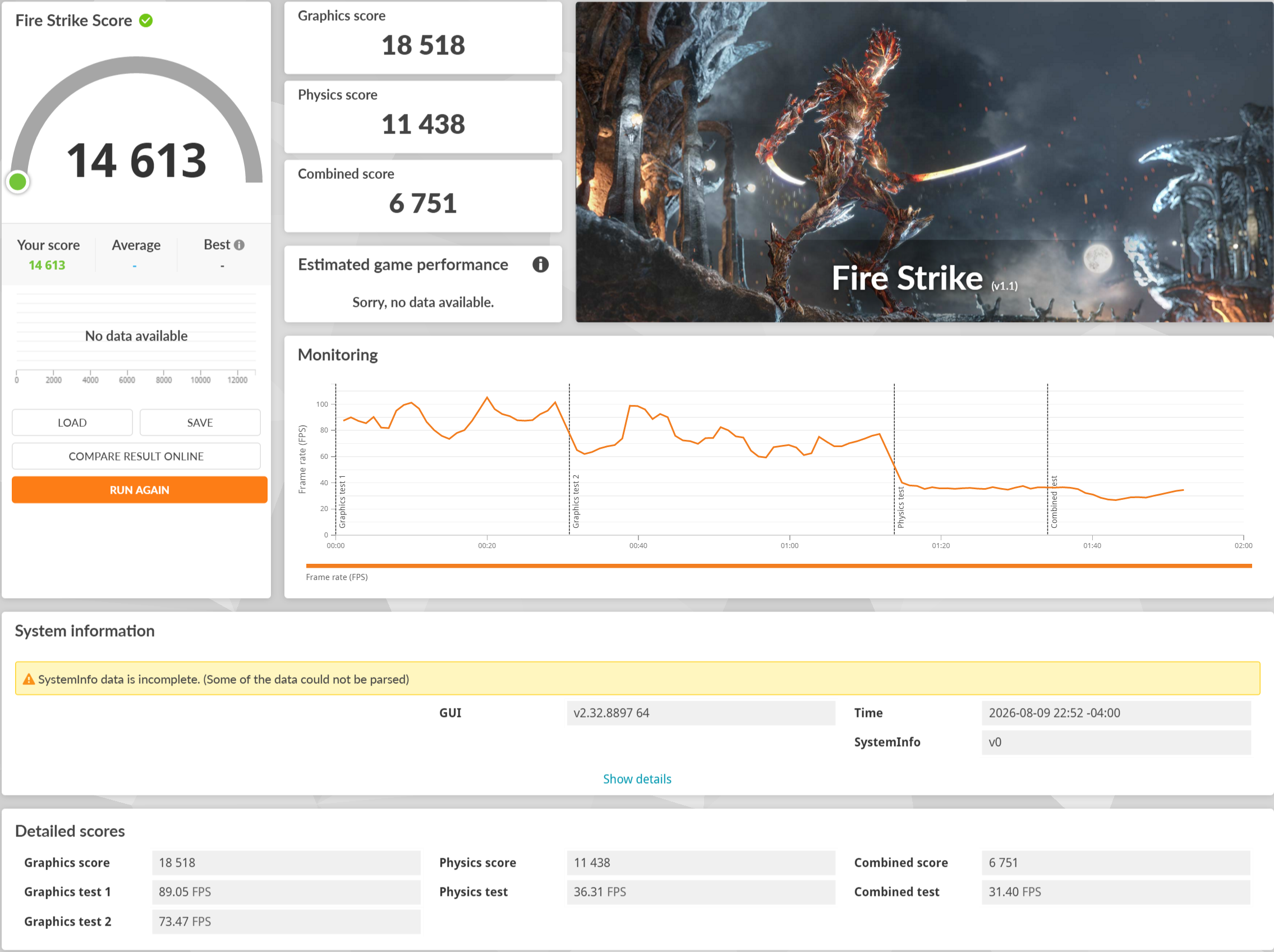
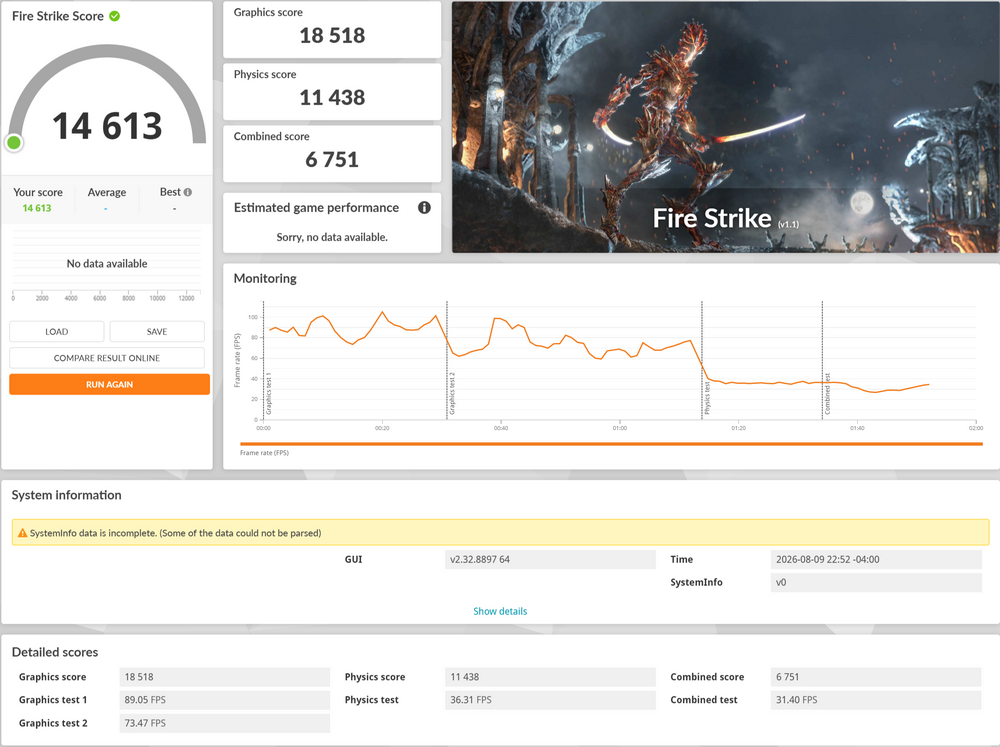
Raising the TDP does work though. This is 125w vs 110w in firestrike: systeminfo doesn't work, but this is on a P150EM with a 3920xm at 4.3ghz that is modded for direct dGPU display output.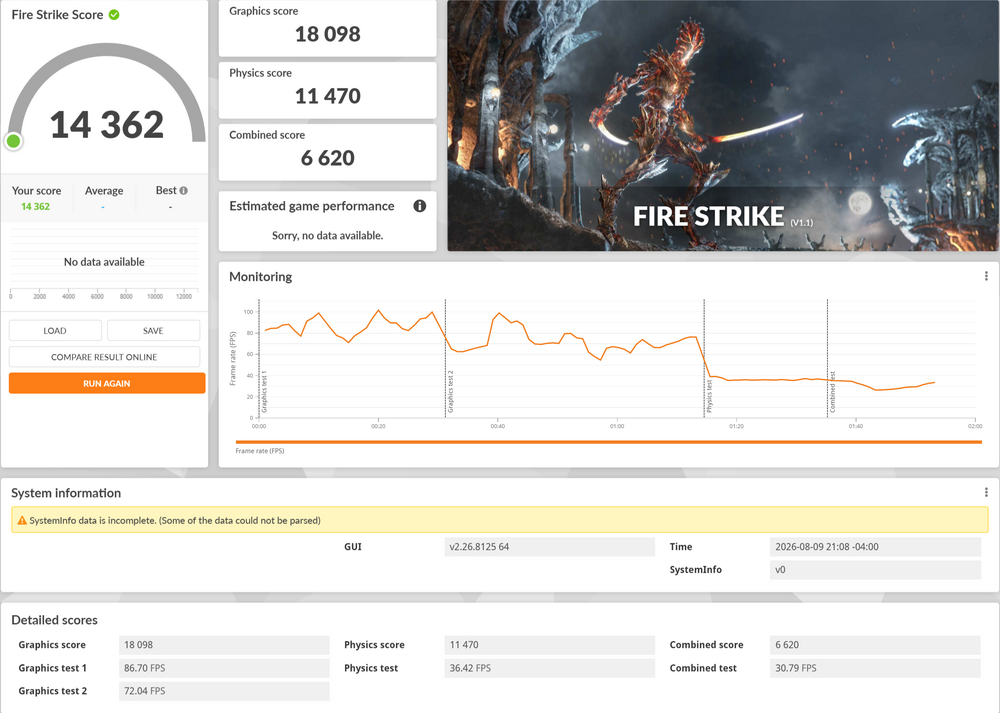
-
Nvidia-vBIOS-Clock-Power-Tweaker - PASCAL TESTING NEEDED !
Khenglish replied to JadeRover's topic in Components & Upgrades
Multimeter. The card runs memory at 1.35V, except for the max speed bin (7.2GHz) runs at 1.5V. The P4000 runs 6GHz at 1.5V since that is its max memory speed. The OC bios had the same issue. No core overclock. RAM would only run 6GHz. The card cannot run an Nvidia driver with the MSI vBIOS. -
Nvidia-vBIOS-Clock-Power-Tweaker - PASCAL TESTING NEEDED !
Khenglish replied to JadeRover's topic in Components & Upgrades
Editing the attached P5200 vBIOS with v1.34 of your tool isn't getting me an overclock. If I overclock vram, the 1.5V speed bin gets ignored and it runs at the 6ghz 1.35V speed bin. Raising the core limit over 1708 is also ignored. Currently I'm trying to set 8GHz on the ram. I am using the #2 memory strap setting on the card instead of #0 like every other P5200 in existence. idk if that matters for vbios vram overclocks. p5200_dell.rom p5200_8000_2.bin -
Nvidia-vBIOS-Clock-Power-Tweaker - PASCAL TESTING NEEDED !
Khenglish replied to JadeRover's topic in Components & Upgrades
Windows is very insistent that v1.3.4 has a virus in it. Also, do you have a way to effectively shift the frequency/voltage curve like normal overclocking? Ex: Can I offset clocks by +150MHz, or does setting a higher core clock just pick a higher frequency/voltage point? -
The 330W power supply should be fine. These systems have a power limit set by the embedded controller and it can cause shut downs. The 9700K can cause very large, very brief power draw spikes that can trigger a shut down when combined with a GPU load. I recommend using Intel XTU to lower the CPU current limit. This should be much less impactful on performance than undeclocking the GPU.
-
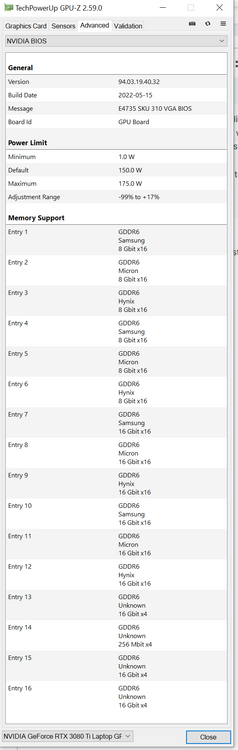
Nvidia memory table resistor encoding map. I'd post an image, but it has Nvidia and Clevo employee names in a watermark: LLL 0 LLH 1 LHL 2 LHH 3 HLL 4 HLH 5 HHL 6 HHH 7 LLM 8 LML 9 LMH 10 LHM 11 MLL 12 MLH 13 MHL 14 MHH 15 HLM 16 HML 17 HMH 18 HHM 19 LMM 20 MLM 21 MML 22 MMH 23 MHM 24 HMM 25 MMM 26 H = 1.8V M = 0.9V L = 0V My vBIOS memory tables: So currently I have HHH = 7 or LMH = 10 for Samsung 16 Gbit x 16. For Samsung 8 Gbit x16 I had LLL = 0 or HLL = 4. What'd odd is for changing to 16GB I remember only changing one resistor, but the tables above indicate I would have needed to change 2 or 3. I'll have to probe around when I can get back to a multimeter.
-
Hey! It was months ago so I forgot what I changed exactly. Basically I changed the memory strap settings from 8GB to 16GB and also unexpectedly got a big clock improvement. You can look up your memory tables in GPUz and try things out. There are actually more Samsung 16GB straps I can try in my vBIOS. I might give them a go. Do you know how to find the memory straps? Nvidia boards have a pretty standard 3x2 resistor pad grouping for strap settings since Pascal. I can share a picture if needed. How did you source HC18 chips? Mine are supposedly HC18 from Aliexpress, but I suspect they're relabeled HC16s. There are 3080 Ti mobile on the ulmark website with higher clocks than me, but I do outclock all 3080s, which have just HC14 chips. With HC14s I could run 17.6GHz stable. With "HC18s" I can run 18.25GHz stable. It would be nice to get memory clocks higher. These cores do seem to like faster RAM when the power limit is increased, which kinda makes sense given that it is supposed to be a 320bit card. This is also one of my guesses on why the 3080 Ti underperforms for the core size. There's a disabled 1MB of L2 that's paired with the disabled 64bit RAM interface. That 1MB is probably supposed to be the local L2 for the 3080Ti's bonus shader cluster vs the 3080, so the Ti has more shaders, but no cache to feed them.
-
Toaster oven is best for soldering and desoldering. It's also good for cleaning off solder after disassembly. Just rub a paper towel on the heat pipes when the solder is wet. You just need to smooth out the old solder. No need to try removing it all. When resoldering I find binder clips work well for pressure. Don't apply too much force with something like a vice or C-clamp. Heatpipes will crush in the middle, greatly impairing their function. Heatpipes will start to expand over 145C. This can be helpful if you do accidentally partially crush one to restore it. They pop at around 210C. Bending heatpipes without kinking them is very difficult. It's best to bend them when they're soldered to something to help keep them in shape. If they are unsoldered, it can also help to loosely fit them into a vice to prevent kinking. If they are already flattened you can't use a pipe bender, but you can use a bender if they are new and unflattened. I typically reuse flattened heatpipes. No added flux is necessary. Whatever the paste has is fine.
-
The 1558 is the clevo subsystem ID. The first 8 digits are the card ID and are as expected. I'm more concerned about the 9900KF mod causing lockups than the 3080. Have you tried a 6000 or 7000 series CPU with the card? If you don't have one to try, try underclocking the CPU to say 4.5GHz.
-
Clevo Z170 with QTJ1 - compatible memory speeds?
Khenglish replied to grisevg's topic in Sager & Clevo
Ram can clock a lot higher if you populate all slots on the channel. With a 9900K I can do 2933 with 2 modules, but with 4 I can do 3466. With that said, only being able to do 2400 sounds low. It sounds like you're using very old DDR4 sticks. Something newer rated for 3200 will clock much better. If the 3200 can't boot at defaults, you can boot with the 2400 stick, set say 2933, then switch the sticks and the 2933 override will stay in place despite the stick change.