
Bublik
-
Posts
20 -
Joined
-
Last visited
-
Days Won
1
Bublik's Achievements






-
Yes, you’re right in principle—the MXM port can deliver 200W—but that doesn’t tell us anything about how the laptop manufacturer designed the power supply. The manufacturer can configure the VRM however it sees fit. It’s still strange, though—I’m at a loss here. Unless… do you happen to have another power adapter on hand? How exactly are you checking to see if the laptop has reset? Maybe I’m just doing something wrong here.

-
Is there any way you can limit your GPU's power consumption? I can't shake the feeling that this is the cause. I mean, the official MXM 3.1A specification calls for 55W, but your GPU uses well over twice that. Maybe some fuses are tripping under load. P.S.: It's amazing that Dell designed in so much headroom in the first place...
-
Yes, you're right. I've read several times that these models are very picky when it comes to power supplies and batteries. I experimented a bit yesterday as well and can confirm that your tip works. But in my case, there don’t seem to be any problems even below 90%. Unlocking the TDP worked at a 57% charge level. The LED on the keyboard is off, and Windows reports “57% available”—in other words, it’s not charging. Just ran Time Spy—no problems, no reset.

-
Hi SuperMG, This is where I bought my battery.

-
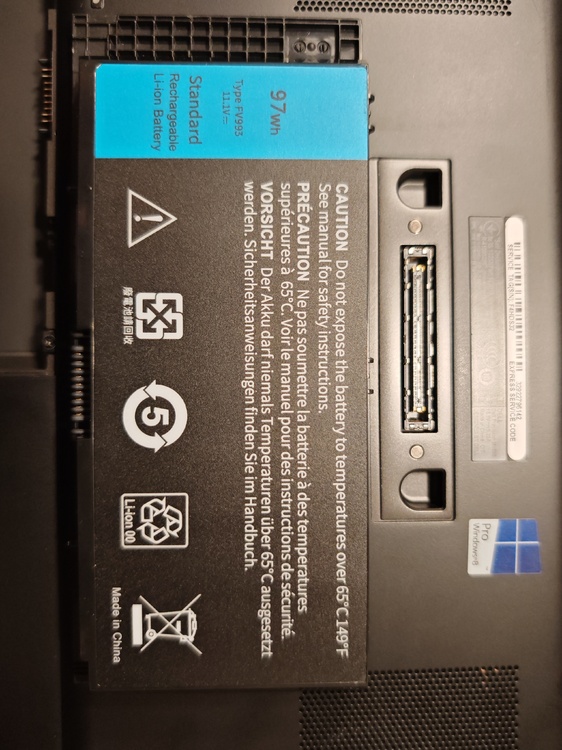
Sure, here's the photo
-
Thanks for the tip—I would never have thought of that 😁 Yeah, I have all the options in the BIOS. The way I use my laptops, it’s not a problem—they’re almost always plugged into the charger. But maybe I should give it a try and set the charge limit to 90%. Let’s see if that triggers the error.
-
You mean this ExpressCharge? Yes, I can enable that in the BIOS.
-
Here's a more detailed breakdown of the process. I have PL1/2 set to 70W. Before the Time Spy test and afterward, I check the TDP with Throttlestop benchmark. I also check under “Limits” to see if anything is being throttled. In my case, nothing is reset, the CPU consistently draws 70W. The battery isn’t the original one—it’s one I bought on eBay. The BIOS is in UEFI mode and is version A26. I’d be happy to test the same thing today with an M6800 and P4000 as well. So far, I haven’t noticed anything unusual there either. And in case it matters, the CPU is a 4980HQ PL1/LP2 47W/58W.
-
Standard run, including the CPU test. Maybe it's due to the total power consumption? I tested all of this using a 180W Dell power supply.
-
Hi. Sorry for the late reply—I finally got around to it yesterday. I tested it on an M4800 edp with a T1000. I didn't experience the problem; I ran the test three times. But my GPU has a maximum TDP of 50W.
-
I'll try it on my M4800, but not until tomorrow. I haven't run Time Spy in a while. We'll see.
-
No, that's not normal. I haven't noticed this kind of behavior on any of my laptops. The TDP remains the same until the laptop is shut down or the power plan is changed... that reminds me—when I unplug the power adapter, the TDP setting also reverts to default values for me. Could it be that your power adapter or power supply is causing a brief interruption under load? I usually test the temperature and power consumption in Throttlestop using the built-in benchmark....
-
Hi SuperMG, Yes, this method always works for me. The only thing is that the battery on my laptops has to be fully charged; as soon as Windows shows the "Charging" status, it doesn't work. Glad to hear you found a solution that works for you 👍 P.S.: You got a really high-quality chip—the power consumption and temperature readings are fantastic!
-
Yeah, I tried that too. I systematically tested everything I could think of—UEFI, CSM, with and without Optimus, plus an external monitor, different VBIOSes—but nothing works. It’s always the same result or error 43 after installing the driver. I think there’s also some kind of hardware coding on the GPU that detects that it’s not the original VBIOS.
-
I tried both versions with FHD displays. The result was the same: the boot process freezes right before the Dell logo appears, without any error messages displayed via the LEDs above the keyboard. However, the GPU gets warm and the fans start spinning. The Adlink user manual specifies that Above 4G is necessary. I then tested the GPU with a Miner PCIe x1 adapter, and it works. But even on the desktop, it only works with the 4G option enabled. Otherwise, it isn’t recognized.