All Activity
- Past hour
-
Let em pop bro @Mr. Fox One by one🙂 The "Magnificent Seven" companies with the largest market capitalization in the US are the ones profiting from AI; the rest are not. The tech industry has focused entirely on AI, investing billions of dollars to buy hardware, train AI models, or simply use it with tokens. The AI bubble has already burst in China: $480 billion has evaporated While the United States and Europe continue to talk about an artificial intelligence (AI) bubble, in China it seems to have already begun to deflate quite rapidly.
- Today
-
This one is dedicated to......
-

*Official Benchmark Thread* - Post it here or it didn't happen :D
Papusan replied to Mr. Fox's topic in Desktop Hardware
First you have this.... NVIDIA says it hasn't discontinued the RTX 5090, but its partners can no longer manufacture them. Rumors about the end of GeForce RTX 5090 GPU production have resurfaced, this time with direct sources within the manufacturing chain. While NVIDIA recently denied that its top-of-the-line graphics card has been discontinued, and that... Then you have this... [Exclusive] GALAX abandons the GPU market: there are not enough NVIDIA chips The situation surrounding NVIDIA graphics cards continues to worsen, and now it may have claimed a major victim: GALAX. According to industry sources, Palit has reportedly decided to close its factory... And this... ZOTAC Puts The RTX 5090 Up For Sale At $7500 In Japan, Even As Board Partners Say They Can No Longer Buy The GB202 Chip Yup, this is spot on...... - Yesterday
-
 HOTFIX joined the community
 -

clevo p870tm/tm1-g Official Clevo P870TM-G Thread
SOYOON replied to ViktorV's topic in Sager & Clevo
.jpeg.07942b48e4663f47af90b5e8681cec4d.jpeg)
-
P775 TM1G question about purchasing a heatsink from aliexpress
SOYOON replied to the jg89's topic in Sager & Clevo
Please, may you sell this heatsink to me??, -
.thumb.png.362386d2804d5f9fbcf2ec7f5aa009c5.png)
*Official Benchmark Thread* - Post it here or it didn't happen :D
Mr. Fox replied to Mr. Fox's topic in Desktop Hardware
So, I got another 8800 CUDIMM kit (Corsair Vengeance) to use in the Unify-X with the CPU I was given by Brother @Talon. I started studying Intel DDR5 memory tuning and learned something new using AI (with links to the points of reference authored by humans). tRTP and tWR should be left on "Auto" because the timings get jacked up. Instead, set tRDPRE instead of tRTP and tWRPRE instead of tWR. (This may apply to AMD as well, but I have not tested it. As you can see in the screenshot, setting tWRPRE to 48 instead of tWR is actually a tighter timing and tWR reads as -2 (left on Auto) and tRDPRE set to 20 reflects tRTP as 20 (left on Auto). This also lowered my latency on L3 Cache. To get tWR to equal 48 you set tWRPRE to 98 if tCWL is 40. You should increase tWRPRE if you want to achieve a target true tWR of 48. The formula Intel use for calculating tWR on DDR5 is: tWR=tWRPRE-tCWL-8 When you set tWRPRE directly to 48, the motherboard's BIOS calculates tWR by subtracting your Write Latency (tCWL) and the DDR5 burst length of 8. Because tCWL is typically equal to or slightly lower than your tCL (which is likely between 30 and 40 on a Z890 setup), subtracting it drops the real tWR value to essentially nothing (hence the -2 rendering or glitching out in your BIOS. What to set: To get a target tWR of 48, you need to work backward using your tCWL value: Formula: tWRPRE = 48 + tCWL + 8 Example 1: If your tCWL is 38, you would set tWRPRE to 94 (48 + 38 + 8). Example 2: If your tCWL is 40, you would set tWRPRE to 96 (48 + 40 + 8). Leave tWR on Auto, adjust tWRPRE upwards based on this formula, and verify in a tool like AsRock Timing Configurator or MemTweakIt that your effective tWR reports at your desired target. (I used Dragon Ball, obviously.) - Last week
-

Alienware 17 R1 980m Upgrade - Which variant to buy?
Eban replied to mattalienware's topic in Alienware 17 and M17x
I agree. Not normal behaviour. My 980m was pretty much plug'n'pray....Your Ranger is possessed I think -
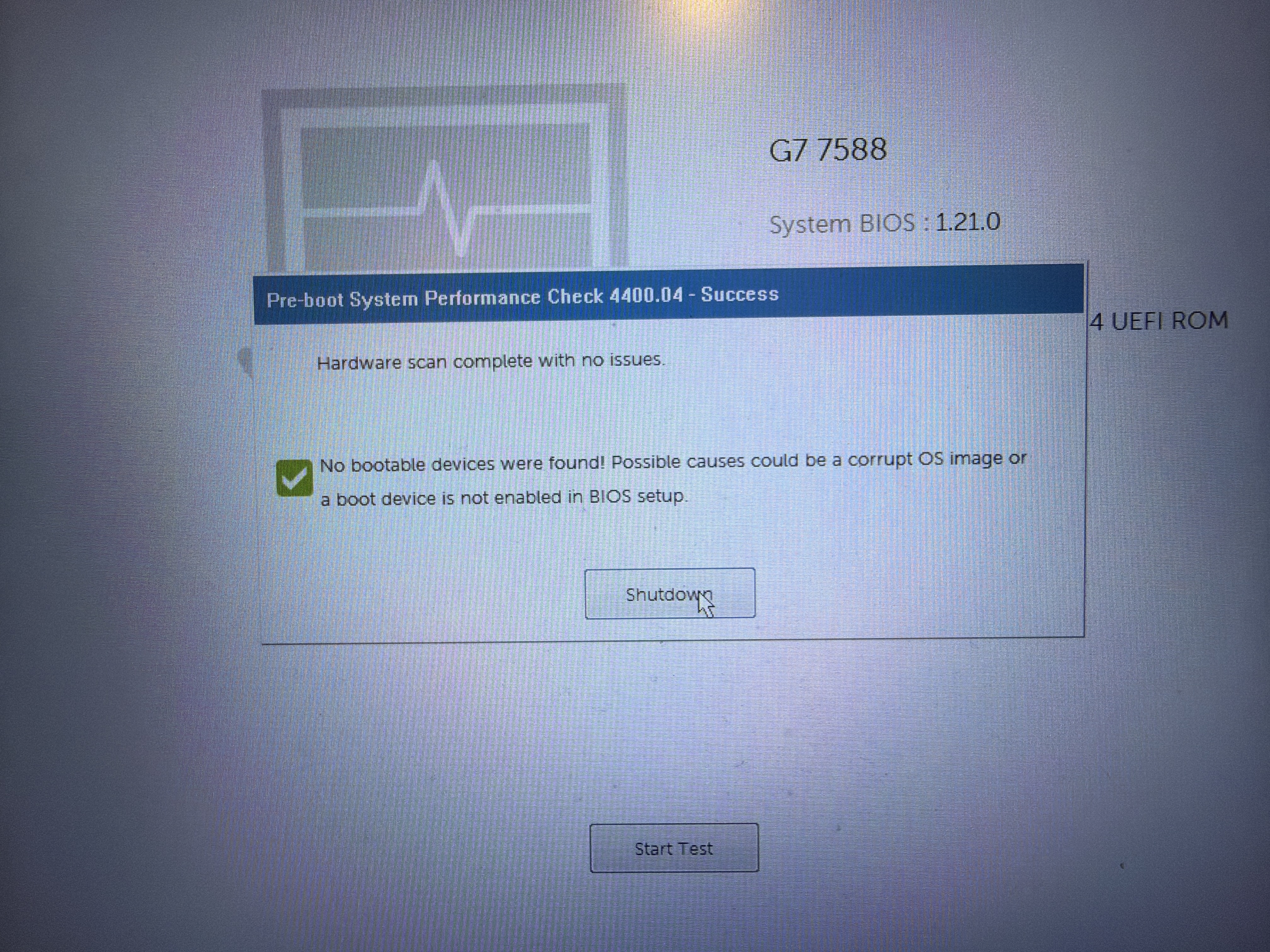
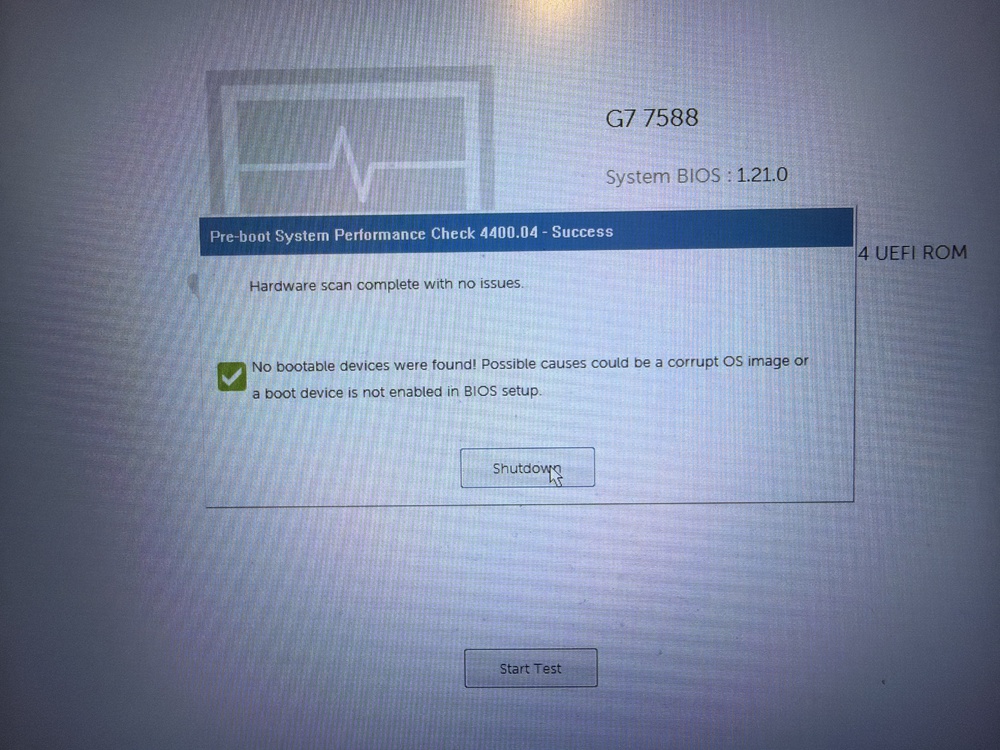
Hello I am experiencing the same issue. Dell G7 7588 Laptop Bootable devices not found diagnostics show the M.2 SSD though. What did you do to fix or enable the bootable devices?
-
 Matty Appleseed joined the community
 -

ADLINK RTX 3000 MXM suddenly died?
Hussain Alhadher replied to Hussain Alhadher's topic in Alienware 17 and M17x
I don’t have one 🫤 -

Alienware 17 R1 980m Upgrade - Which variant to buy?
mattalienware replied to mattalienware's topic in Alienware 17 and M17x
It is odd behaviour isn't it...it must be a firmware issue. Maybe I should install an unlocked BIOS to put it in PEG mode. I believe I can only do SG mode now with regular A13 bios and my 1080p 60hz LVDS display. I don't have another system to test the 980m in. But it's a backup option, I could always buy one. -
Hey mate sounds like a great project! Here's a link to the service manual / schematic for the board, you might be able to find something unused on here https://www.e-weekly.co.uk/download/rnd/drivers/clevo/p775tm1/esm.pdf?lce
-

ADLINK RTX 3000 MXM suddenly died?
loopster replied to Hussain Alhadher's topic in Alienware 17 and M17x
Just a wild guess, a dodgy resistor on some signal line maybe... Do you have a multimeter? -
Hello folks! I’m currently modding my Clevo’s keyboard. Like on lots of these machines, my keyboard backlight burned out, and I’m not in the mood at all to buy a new keyboard just because of that. So far, I’ve completely replaced the stock LED strip with an addressable one. It works as intended and is a huge upgrade over the stock LEDs, but it’s still far from perfect. I’m controlling the LEDs with a Nollie 1 controller, which works with either SignalRGB or OpenRGB, completely bypassing Clevo’s crappy software. The problem I’m facing now is finding an unused USB port to connect the controller to. I thought about using the webcam or fingerprint reader data lines, but I don’t want to lose any features for this mod. So, the big question: does anyone know of unused pads on the motherboard that I could connect the controller to? That would be awesome for this mod! I’ll post a follow-up once I’m done with it. Thanks!
-
ADLINK RTX 3000 MXM suddenly died?
Hussain Alhadher replied to Hussain Alhadher's topic in Alienware 17 and M17x
Cleared CMOS and sometimes it reports Nvidia gfx and sometimes not -
ADLINK RTX 3000 MXM suddenly died?
Hussain Alhadher replied to Hussain Alhadher's topic in Alienware 17 and M17x
I’ve run into another problem with my M17x R4, and I honestly don’t know what to do now. 😞 I recently got my Quadro RTX 3000 repaired, and the GPU was working again. However, when I came back to use the laptop a few days later, the Quadro was no longer being detected. I checked the BIOS, and under Discrete Graphics it says “Not Detected.” Windows only shows Intel HD Graphics 4000. I tried reinstalling my original GTX 765M to see if the Quadro was the problem, but the BIOS still says “Not Detected” with the 765M as well. I also tried a full power reset, but it didn’t help. At this point, I’m wondering if the MXM slot or something on the motherboard, such as the GPU power circuitry or PCIe connection, has failed. I haven’t confirmed the cause yet, though. It’s frustrating because I just got the Quadro working again, and now another problem has appeared. Has anyone experienced something similar on an M17x R4? Any suggestions on what I should check next would be greatly appreciated. -

Clevo P570WM can't overclock Xeon E5-1680 v2 to 4GHz and beyond
SuperMG replied to SuperMG's topic in Sager & Clevo
How do these people get the 1.47V reading? I'm stuck at max 1.281V!!! I used Prema BIOS V5 from 1/03/2015 with 1.03.03 EC. I just want to have 4.2GHz without any errors on TSBench. -
*Official Benchmark Thread* - Post it here or it didn't happen :D
Mr. Fox replied to Mr. Fox's topic in Desktop Hardware
Probably so. Unless it is priced like a 9950X3D2 (or worse). The thing I like a lot about the 270K Plus is that it performs better than 9950X at half the cost, and overclocks much better (both CPU and memory). -

*Official Benchmark Thread* - Post it here or it didn't happen :D
Raiderman replied to Mr. Fox's topic in Desktop Hardware
Ahh, you will miss it in a couple months when the 24 core 48 thread 10950x drops 🤣 -
Alienware 17 R1 980m Upgrade - Which variant to buy?
SuperMG replied to mattalienware's topic in Alienware 17 and M17x
That's not a normal behavior. Did you use the DDU tool to remove the previous Nvidia drivers? Did you try the card in PEG LVDS? I never received such error with any cards such as the Nvidia GTX 980M, 970M, P5200, P3000, RTX 3000, RTX 5000, RTX 3080, RTX 3060, RTX 4070, RTX 4080 and 4090 MXM cards. Did you try the card in another system? Do you have proof that this card worked before with Nvidia drivers? -
Alienware 17 R1 980m Upgrade - Which variant to buy?
mattalienware replied to mattalienware's topic in Alienware 17 and M17x
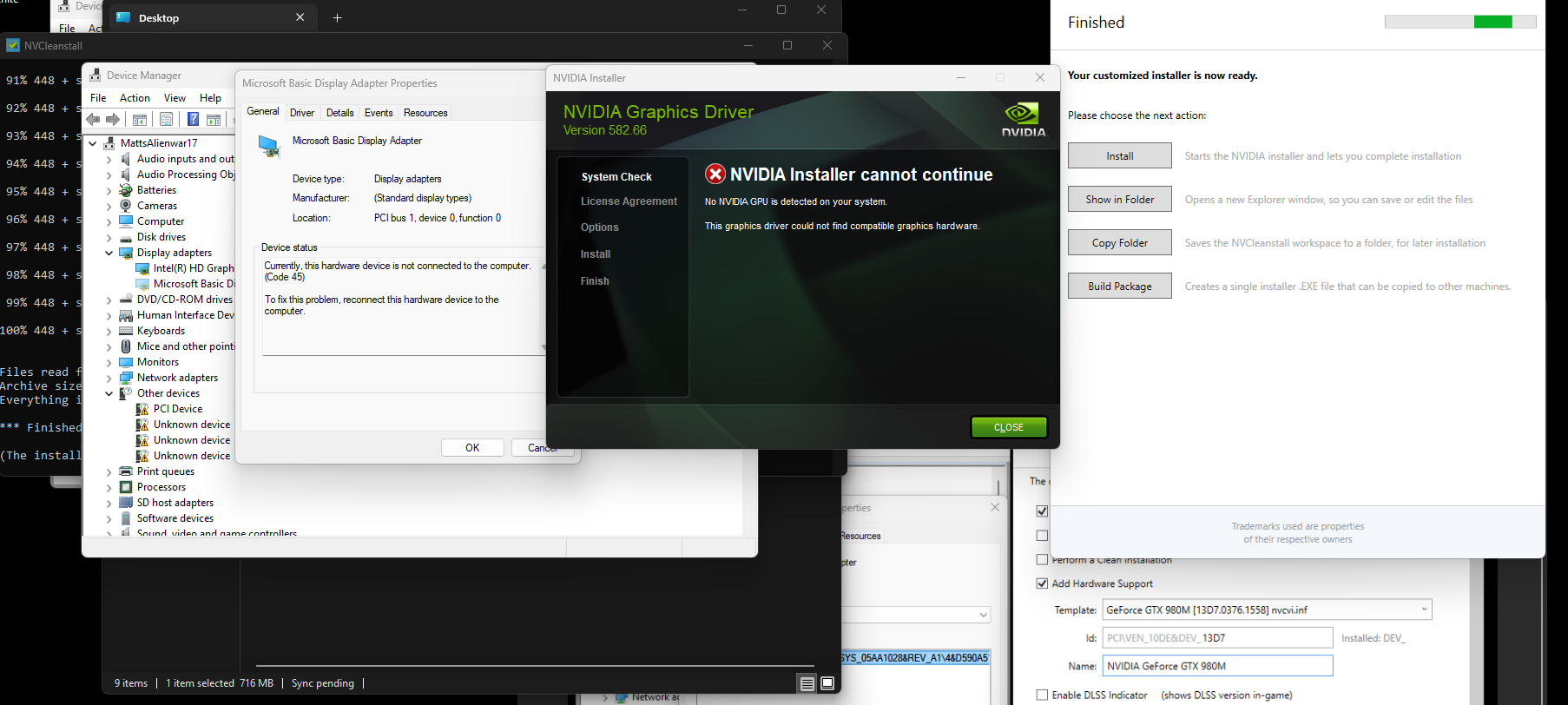
Hi @SuperMG, I entered it manually per the screenshot. Built the package and ran it as administrator. Unfortunately the installer failed (no NVIDIA GPU detected on your system). Maybe it's because I am getting code 45 in device manager? The GPU is hidden in device manager. When I first installed the physical gpu into the mxm slot and booted it, it appeared in device manager as a normal working device. Then when I restarted the laptop, it appeared greyed out and hidden in device manager with the code 45. This is most likely causing the problem. Is that normal behaviour when installing a GPU that was never officially supported for a laptop?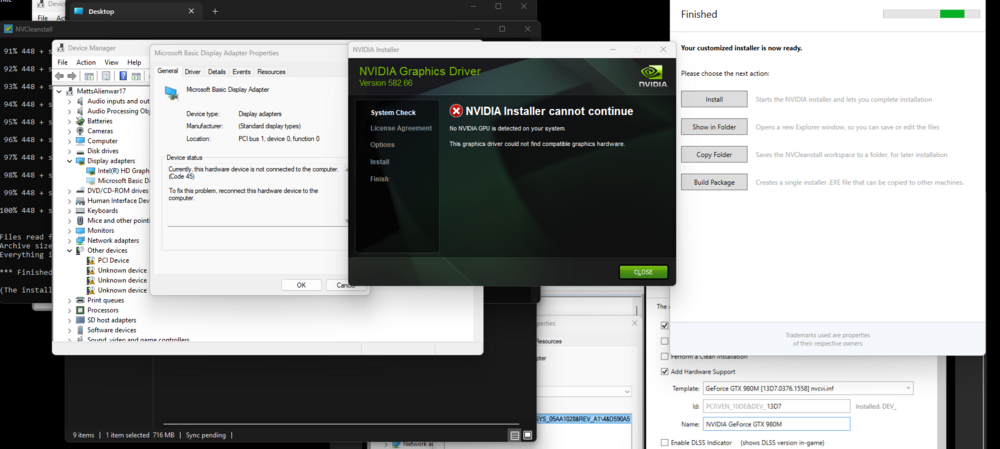
-
Alienware 17 R1 980m Upgrade - Which variant to buy?
SuperMG replied to mattalienware's topic in Alienware 17 and M17x
Yes you can manually do it. Normally it should SHOW the GPUID on the software. -
Alienware 17 R1 980m Upgrade - Which variant to buy?
mattalienware replied to mattalienware's topic in Alienware 17 and M17x
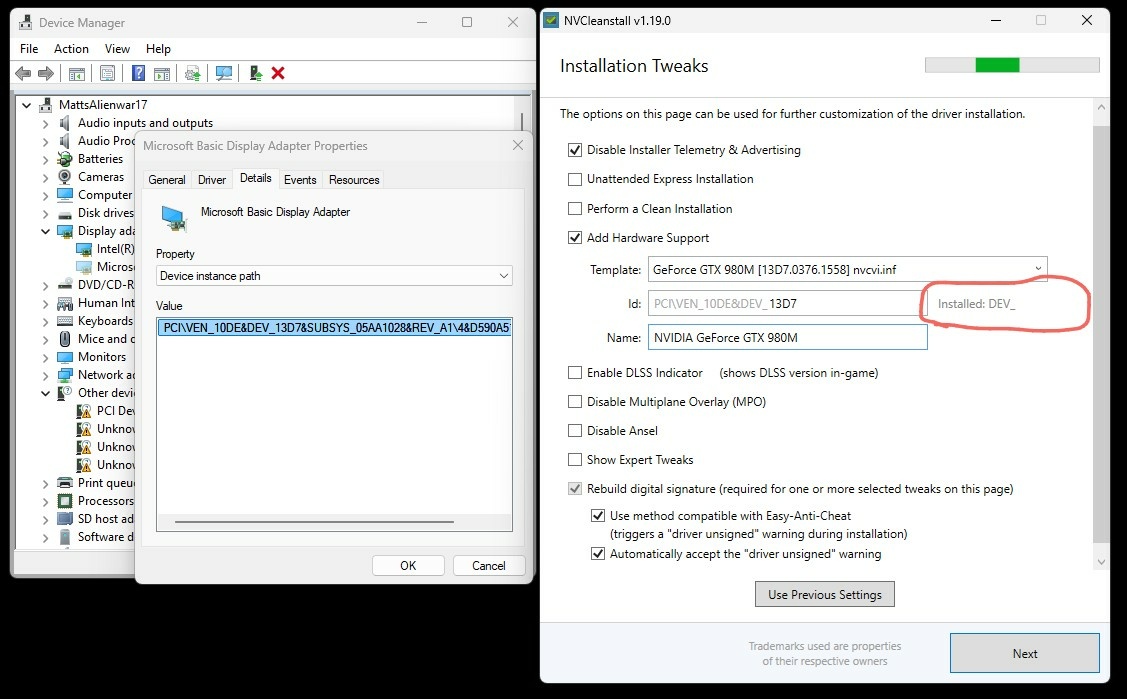
Hi @SuperMG, Thanks. I've looked at your PDF. I came across one issue. On the installation tweaks page, step 3 where your guide says click on Installed: Dev_ there is supposed to be a device ID. However, I do not have a device ID showing there. It is blank. Is that an issue? Can I just manually fill it in? See attached screenshot. Thank you!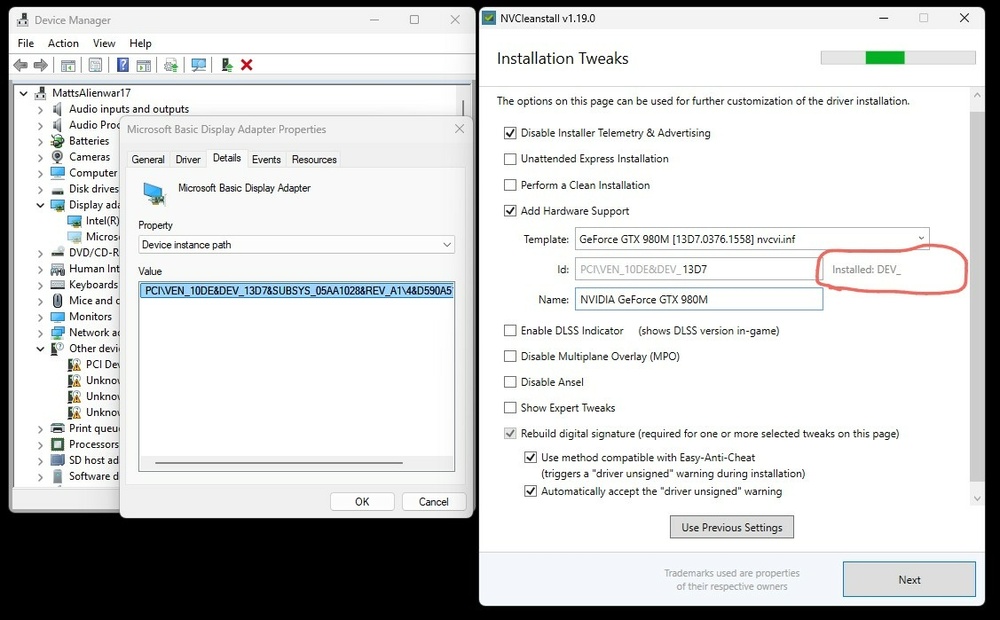
-
Alienware 17 R1 980m Upgrade - Which variant to buy?
SuperMG replied to mattalienware's topic in Alienware 17 and M17x
Use nvcleanstall software. Your method is obsolete. I have a PDF instructions manual for it, page 8: https://drive.google.com/file/d/12J9CSd7BccNmFtcskdBwuiTa_AJhyyZG/view -
Alienware 17 R1 980m Upgrade - Which variant to buy?
mattalienware replied to mattalienware's topic in Alienware 17 and M17x
Okay the laptop is all back together. I followed mrfox's instructions. Turned it on, beeped continuously, restarted, quickly put a stick of ram in, then it beeped 5 times. Turned it off. Turned It on. Booted into windows. And now device manager is showing Microsoft basic display adapter THANK YOU. Now I am trying to mod the .inf file. I downloaded the oldest driver for my 980m (572.83) on the NVIDIA website. When I run the driver, I see the NVIDIA folder appear in C drive. I tried to mod it, but I could only see GTX 980 and 980 Ti, I couldn't see 980m. So I just edited the bits for the GTX 980 but I was unsuccessful, the driver still failed. Also, the devices at the bottom of the .inf file only had the device ID, not the other 8 character string (system ID?) that usually comes after the decide ID. So I have downloaded 5+ newer drivers, but none of them have the NVIDIA folder appearing in the C drive, so cannot mod the .inf files. I will keep trying to download more drivers until one has the NVIDIA folder appear again and try to mod the .inf. It should be possible. -
Hi guys. Has anybody a modified Bios to support NVMe SSD‘s?